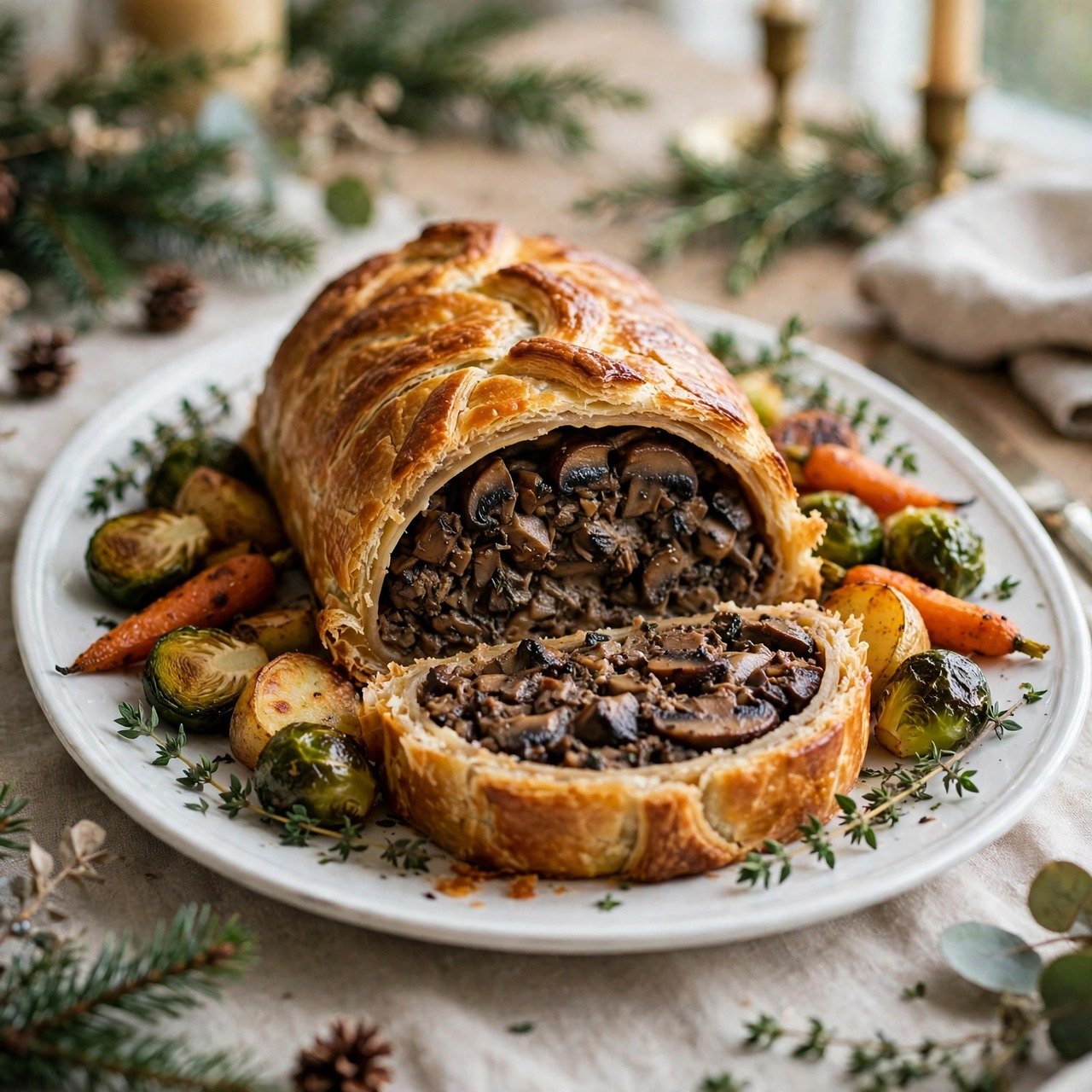
A mushroom Wellington turns humble mushrooms into a centerpiece worth photographing. Crisp, golden puff pastry gives way to a deeply savory filling, rich with garlic, thyme, and a whisper of wine. Below is one reliable base method plus five distinct ways to make it your own.
Why You’ll Love This Mushroom Wellington
This is the rare vegetarian main that does not feel like a compromise. Mushrooms bring the same deep, meaty satisfaction as a roast, especially when cooked down until their flavor concentrates. The duxelles — finely chopped mushrooms cooked with shallots and herbs — becomes almost spreadable, so every slice holds together.
It is also more forgiving than it looks. Puff pastry does most of the visual work, and the filling can be made a day ahead. Once you know the key steps — drying the filling, chilling the roll, and letting it rest — you can make this with confidence.
Ingredients You’ll Need
These quantities make one large Wellington that serves six to eight people.
- 2 lb mixed mushrooms (cremini and shiitake), finely chopped
- 2 tbsp olive oil and 2 tbsp unsalted butter
- 1 large shallot, finely diced, and 3 garlic cloves, minced
- 2 tsp fresh thyme leaves and 1 tbsp chopped fresh parsley
- 1/4 cup dry white wine or vegetable broth
- 1/2 cup panko breadcrumbs and 1/4 cup grated Parmesan
- 1 sheet puff pastry (about 14 oz), thawed but cold
- 1 large egg, beaten with 1 tbsp water, for egg wash
- 1 tsp Dijon mustard, 1/2 tsp kosher salt, and 1/2 tsp black pepper
Choose mushrooms that feel firm and dry. A mix gives the best flavor: cremini for earthiness, shiitake for depth, and portobello for body. Keep the pastry cold — warm pastry turns sticky and will not puff properly.
How to Make Mushroom Wellington
- Brown the mushrooms in batches. Heat the oil in a large skillet over medium-high heat. Add half the mushrooms in a single layer; cook 4 to 5 minutes until browned, stir, and cook 3 to 4 minutes more. Repeat. Crowding the pan steams mushrooms instead of browning them, and browning is where the flavor lives.
- Build the duxelles. Melt the butter over medium heat. Cook the shallot 2 to 3 minutes until soft, then the garlic and thyme for 30 seconds. Return the mushrooms, add the wine, and cook 6 to 8 minutes, stirring often, until dry and holding together when you drag a spoon through it. Wet filling makes soggy pastry. Stir in the salt, pepper, Dijon, breadcrumbs, and Parmesan.
- Cool and chill the filling. Spread the duxelles on a baking sheet, cool 15 minutes, then refrigerate at least 30 minutes until cold. Warm filling melts the pastry butter before baking, which kills the flaky layers.
- Shape the roll. On plastic wrap, spread the cold filling into a firm log about 10 inches long and 3 inches wide. Roll tightly, twist the ends, and chill 20 minutes for a neat cylinder that is easy to wrap.
- Wrap in pastry. Heat the oven to 400°F and line a baking sheet with parchment. Roll the pastry to about 12 by 14 inches. Place the log in the center, brush the edges with egg wash, fold the long sides over, then fold the ends underneath. Place seam-side down.
- Score and glaze. Brush the roll with egg wash. Score light diagonal lines across the top with the back of a knife — do not cut through. The cuts let steam escape, so the pastry rises evenly instead of bursting. Sprinkle with flaky salt and thyme.
- Bake until deeply golden. Bake 30 to 35 minutes, until puffed and rich golden brown and the bottom sounds crisp when tapped. If the top browns too fast, tent loosely with foil for the last 10 minutes. The center should read at least 165°F.
- Rest before slicing. Rest for 10 minutes. The filling firms up and the pastry sets in that time. Slice with a sharp serrated knife using a gentle sawing motion, and serve warm.
Tips for the Best Mushroom Wellington Every Time
Dry the filling completely. If a spoonful still shows liquid, keep cooking. A dry duxelles is the best defense against a soggy bottom.
Keep everything cold. Chill the filling and the shaped log, and work with cold pastry. Cold butter turns to steam in a hot oven, and that steam lifts the layers into flakes.
Bake on a hot surface. A preheated baking sheet under the parchment helps the base crisp instead of steaming. If your oven runs cool, add 5 minutes and judge by color, not just time.
Fix a crack quickly. If the pastry splits while baking, brush egg wash over the crack — it will seal. After baking, parsley and flaky salt make a small crack look intentional.
Do not skip the rest. Cutting too soon sends hot filling spilling out and leaves the pastry soft. Ten minutes is the difference between clean slices and a puddle.
Easy Variations
1. Classic Mushroom Wellington
The base recipe above, exactly as written — pure mushroom flavor, buttery pastry, and a clean slice every time. Serve with roasted green beans and a simple gravy.
2. Spinach and Ricotta Mushroom Wellington
Fold 1 cup of well-squeezed cooked spinach and 3/4 cup of whole-milk ricotta into the cooled duxelles. Squeeze the spinach until almost no water comes out — wet spinach is the fastest way to a soggy center. A pinch of nutmeg ties the flavors together.
3. Chestnut Mushroom Wellington
Add 1 cup of finely chopped roasted chestnuts and 1 tablespoon of sherry as the duxelles finishes cooking. The chestnuts stay slightly chunky, adding nutty sweetness and bite. This festive version pairs well with cranberry sauce and roast potatoes.
4. Vegan Mushroom Wellington
Swap the butter for olive oil, replace the Parmesan with 1/4 cup of nutritional yeast, and brush the pastry with oat milk and a teaspoon of maple syrup instead of egg wash. The maple helps the pastry brown. Use a vegan puff pastry — most frozen brands already are.
5. Mini Individual Mushroom Wellingtons
Divide the filling into six portions and shape each into a small log. Cut the pastry into six rectangles, wrap each log, and seal well. Bake at 400°F for 20 to 24 minutes, until golden and puffed. Minis suit a buffet, and you can make two vegan and four classic from one batch.
Storage and Reheating
Let leftovers cool completely, then wrap tightly and refrigerate for up to 3 days. Freeze individual slices wrapped in plastic and foil for up to 2 months; thaw overnight in the refrigerator.
Reheat in a 350°F oven for 12 to 15 minutes, until warmed through and crisp again. Avoid the microwave: it turns puff pastry soft and chewy in under a minute. From frozen, add 10 minutes and cover loosely with foil until the last 5 minutes.
Frequently Asked Questions
Can I make mushroom Wellington ahead of time? Yes. Make the duxelles up to 2 days ahead. You can also assemble the roll, wrap tightly, and refrigerate overnight. Bake straight from the fridge, adding 3 to 5 minutes.
Why did my Wellington get a soggy bottom? Usually a wet filling or an oven that was not hot enough. Cook the duxelles until dry, chill it fully, and bake on a preheated sheet at 400°F.
Can I use store-bought puff pastry? Absolutely. Keep it thawed but cold, and do not re-roll it too thin. If it softens, chill it 10 minutes before shaping.
What mushrooms work best? A mix is best: cremini for base flavor, shiitake for depth, and portobello for body. Avoid only white button mushrooms — they are milder and release more water.
Can I freeze a mushroom Wellington? Yes, before or after baking. Freeze the unbaked roll until firm, then wrap well; bake from frozen at 375°F for 45 to 50 minutes. Or freeze baked slices and reheat in the oven.
What should I serve with it? Roasted vegetables, mashed potatoes, a green salad, and a simple gravy all work well. The Wellington is rich, so a sharp side — pickled red onions or a lemon-dressed salad — keeps it balanced.
Nutrition Estimate
These values are an estimate only, for one serving (one-eighth of the classic Wellington) using typical ingredient values. Actual numbers will vary with the pastry brand, mushroom mix, and variations chosen. This is not medical or dietary advice.
Per serving, the classic version is approximately 340 calories, with about 11 g protein, 32 g carbohydrates, 20 g fat, 3 g fiber, and 420 mg sodium. The spinach and ricotta version adds protein and calcium, while the vegan version is slightly lower in saturated fat.
The Bottom Line
A mushroom Wellington earns its place at the center of the table. Dry the filling, chill the roll, bake until truly golden, and rest it before slicing — get those four things right and the rest takes care of itself.