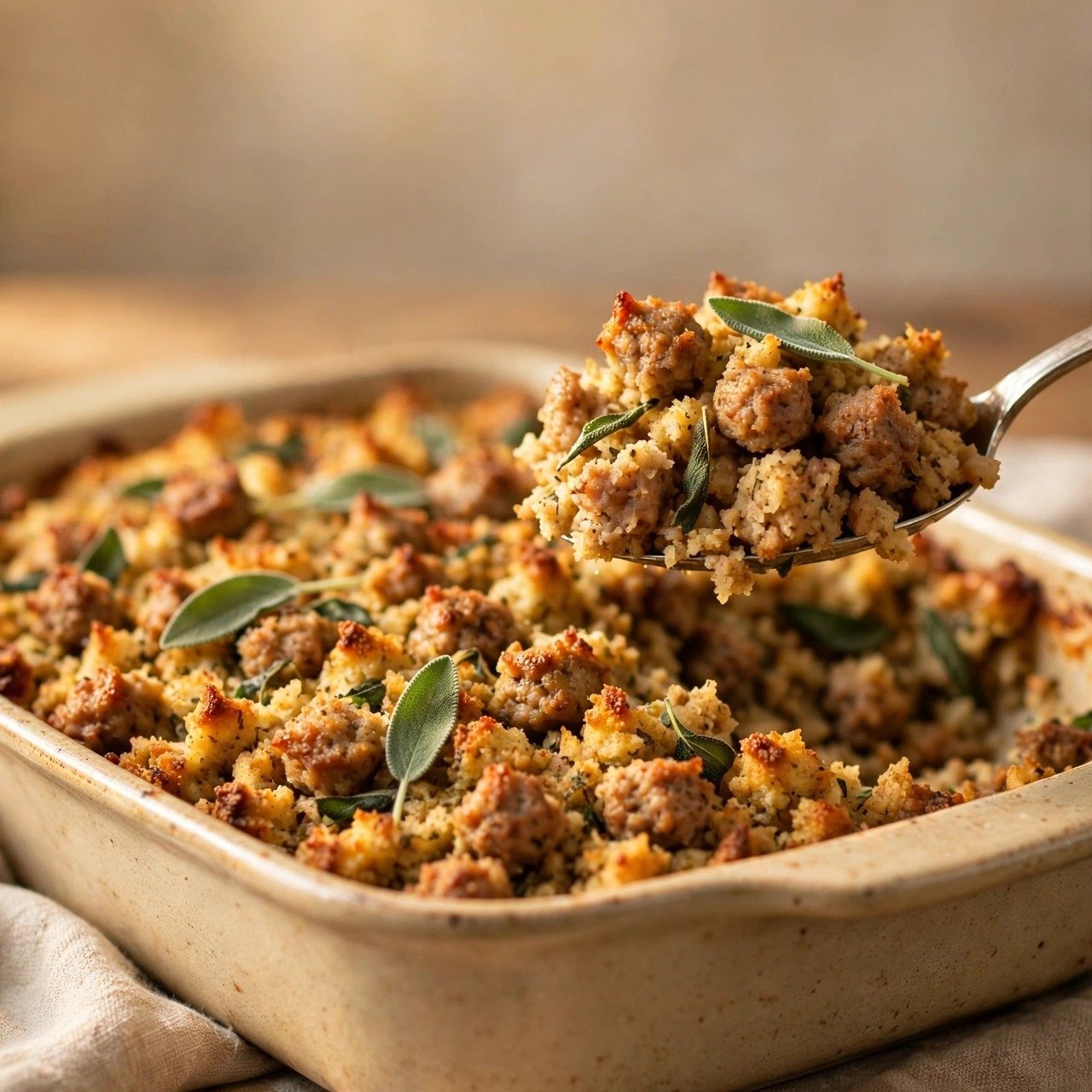
Why You’ll Love This Sausage Sage Stuffing
This is the side dish that disappears first at Thanksgiving: pork sausage browned until crisp at the edges, fresh sage, onion and celery softened in butter, and crusty bread cubes that soak up rich broth without falling apart. Baked at 375°F, it has a golden-brown, crackling top and a soft, deeply seasoned center.
The method is what sets it apart: dried bread cubes absorb broth instead of collapsing into mush, sausage browned in its own fat builds caramelized flavor no later seasoning can replace, and a ten-minute rest before baking lets the bread drink in the broth evenly.
Ingredients You’ll Need
Serves 8 to 10 as a side dish.
- 1 lb pork sausage, bulk or removed from casings
- 12 cups crusty bread cubes, cut into 3/4-inch pieces and dried
- 4 tbsp unsalted butter, plus more for the dish
- 1 large yellow onion, finely diced (about 2 cups)
- 3 celery stalks, finely diced (about 1 1/2 cups)
- 3 garlic cloves, minced
- 2 tbsp fresh sage leaves, finely chopped
- 1 tbsp fresh thyme leaves
- 2 large eggs, lightly beaten
- 2 1/2 to 3 cups low-sodium chicken or turkey broth, warmed
- 1 tsp kosher salt, 1/2 tsp black pepper, 1/4 tsp ground nutmeg
- Fresh parsley, chopped, for serving
Use sturdy bread such as sourdough or French bread; soft sandwich bread turns gummy. If your loaf is fresh, cut it the night before and leave the cubes to dry, or dry them in a 300°F oven for 20 to 25 minutes until firm outside.
How to Make Sausage Sage Stuffing
- Preheat and prepare. Heat the oven to 375°F and butter a 9×13-inch baking dish.
- Brown the sausage. In a large skillet over medium-high heat, break the sausage into small crumbles and cook 8 to 10 minutes until deeply browned and no pink remains. Scoop it onto a plate with a slotted spoon, leaving the fat in the pan.
- Soften the vegetables. Reduce the heat to medium, melt the butter into the drippings, and cook the onion and celery with a pinch of salt for 7 to 8 minutes until translucent. Stir in the garlic, sage, and thyme and cook 60 seconds more, just until fragrant.
- Combine. In a large bowl, combine the bread, sausage, and vegetables with all the pan drippings. Season with salt, pepper, and nutmeg, and toss gently.
- Add liquid and rest. Whisk the eggs into 2 1/2 cups of warmed broth, pour evenly over the bread, and fold together. Rest 10 minutes so the broth soaks in evenly; the cubes should feel moist through but not dripping. If the centers still feel dry, add the remaining 1/2 cup a few spoonfuls at a time.
- Bake until golden. Spread in the dish without packing it down. Cover with foil and bake 30 minutes, then uncover and bake 20 to 25 minutes more, until the top is golden-brown and crisp and the center feels set. If cooking it inside the turkey, it must reach 165°F inside — check with a thermometer before serving.
- Rest and serve. Let the stuffing stand 10 minutes so the crumb firms up, then serve warm.
5 Sausage Sage Stuffing Recipes
The classic base above is the starting point; each variation changes only a few ingredients, so follow the same method and timing.
1. Classic Sausage Sage Stuffing
The base recipe exactly as written — pork sausage, fresh sage, onion, celery, and crusty bread, baked at 375°F until the top turns golden and crisp.
2. Cornbread Sausage Stuffing
Swap half the crusty bread (6 cups) for 6 cups of crumbled day-old cornbread. Cornbread absorbs broth faster, so start with only 2 cups, adding more a quarter cup at a time until moist but not wet. Add 1/2 cup of diced red bell pepper with the onion and celery. The result is softer, with a subtle sweetness that pairs well with ham or smoked turkey.
3. Apple Cranberry Sausage Stuffing
Add 1 1/2 cups of diced Honeycrisp or Granny Smith apple and 3/4 cup of dried cranberries before adding the broth, and reduce the salt to 3/4 teaspoon. The apple turns sweet-tart and the cranberries add bright color and acidity that cut through the sausage richness.
4. Spicy Italian Sausage with Peppers
Use 1 lb of hot Italian sausage, and add 1 diced red bell pepper and 1 diced poblano with the onion and celery. Stir in 1/2 teaspoon of red pepper flakes with the sage, and swap the thyme for 1 tablespoon of chopped fresh oregano. The peppers sweeten as they cook, balancing the heat.
5. Slow Cooker Sausage Stuffing
Follow steps 2 through 5 on the stovetop, then transfer to a greased 6-quart slow cooker. Use only 2 cups of broth — the sealed lid traps steam. Cook on low 3 to 4 hours or on high 1 1/2 to 2 hours, until hot and set. For a crisp top, broil in a baking dish for 3 to 4 minutes just before serving.
Tips for the Best Sausage Sage Stuffing Every Time
Dry the bread properly. This is the biggest factor between great stuffing and soggy stuffing. Cubes still soft inside collapse as soon as broth touches them; cubes dried through keep their shape and absorb liquid gradually. When in doubt, dry them longer — over-dried bread can always take more broth, but soggy bread cannot be rescued.
Brown, do not just cook, the sausage. Gray, steamed sausage adds almost no flavor. Let the meat sit undisturbed for a minute or two between stirs so it browns against the hot pan. That browning — the Maillard reaction — creates most of the deep, savory flavor here.
Warm your broth and do not over-pack the dish. Cold broth slows absorption; warm broth soaks in faster and more evenly. Spread the stuffing loosely — a deep, packed layer steams in the middle and never develops a golden crust. Taste a piece of bread for salt once the broth is in, since seasoning cannot be fixed after baking.
Easy Variations
For richness, replace 1 cup of broth with heavy cream and add 1/2 cup of grated Parmesan. For crunch, fold in 3/4 cup of toasted chopped pecans or walnuts before baking. For a vegetarian version, use plant-based sausage and vegetable broth plus 8 oz of sautéed mushrooms. For gluten-free, use a sturdy gluten-free loaf, dried the same way.
Storage and Reheating
Cool leftovers completely, then refrigerate in an airtight container for up to 4 days, or freeze for up to 3 months; thaw overnight in the refrigerator. To reheat, place in a buttered dish, sprinkle 2 to 3 tablespoons of broth over the top, cover with foil, and warm in a 350°F oven for 20 to 25 minutes, uncovering for the last 5 minutes to crisp the top. Never leave cooked stuffing at room temperature for more than 2 hours.
Frequently Asked Questions
What is the difference between stuffing and dressing? They are the same dish cooked in different places: stuffing inside the turkey, dressing baked separately. This recipe is a baked dressing, which cooks evenly and develops a crisp top.
Can I make sausage sage stuffing ahead of time? Yes. Assemble it up to one day ahead and refrigerate unbaked, covered tightly. Let it sit at room temperature for 30 minutes, then bake as directed, adding 5 to 10 minutes since it starts cold.
How do I keep stuffing from drying out? Use the full 2 1/2 cups of broth, adding more if the bread still feels dry after resting. Bake covered for 30 minutes so the interior stays moist, then uncover for the final 20 to 25 minutes to crisp the top.
Is it safe to stuff the turkey? Yes, if you follow the rules: stuff the cavity loosely just before the turkey goes in — never the night before — with warm stuffing. The stuffing must reach 165°F in the center, and the turkey 165°F in the thigh.
Why did my stuffing turn out soggy? It usually comes from bread that was not dried enough, too much broth, or a dish packed too tightly so it steamed instead of baked. Next time, dry the cubes until firm and add broth gradually. If this batch is already soggy, spread it on a baking sheet and bake at 375°F for 10 to 15 minutes.
Nutrition Estimate
Nutrition Estimate: Per serving (10 servings of the classic recipe), approximately 310 calories, 14 g fat, 34 g carbohydrates, 3 g fiber, 12 g protein, and 620 mg sodium. These values are an estimate only; actual nutrition varies with the sausage, bread, and broth you use.
The Bottom Line
This stuffing earns its place at Thanksgiving by doing the simple things well: bread dried until it holds its shape, sausage browned until it tastes like something, fresh sage used generously, and broth added slowly so every cube is seasoned. Make the classic once, then make it your own.