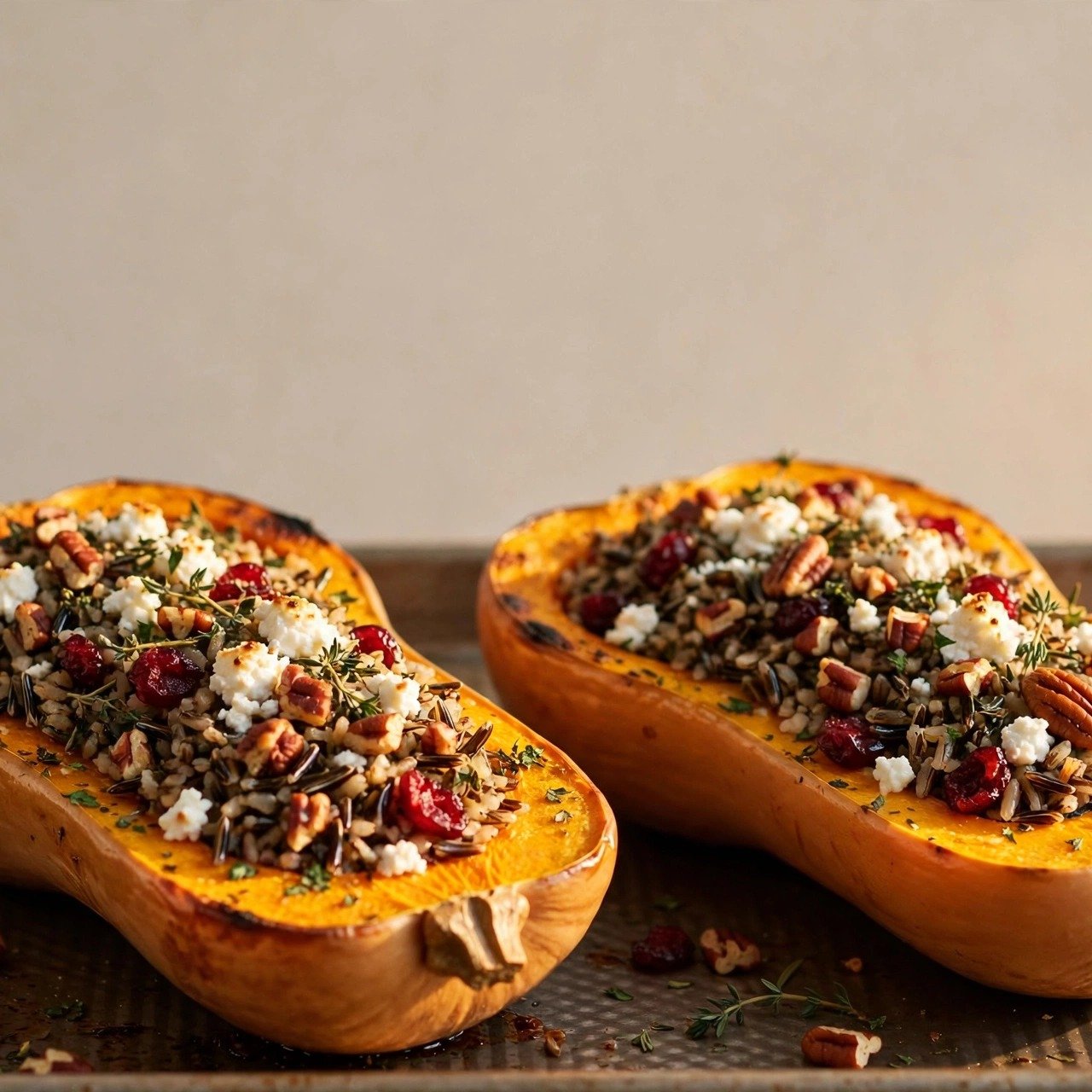
When the Thanksgiving table needs a vegetarian main that still feels like a celebration, stuffed butternut squash delivers. Roasted until caramelized at the edges and tender all the way through, each half becomes its own edible bowl, filled with nutty wild rice, tart cranberries, toasted pecans, and savory herbs. It looks impressive, slices beautifully, and satisfies vegetarians and meat-eaters alike. This guide walks you through the flagship wild rice version, then gives you five variations so you can make it your own all season.
Why You’ll Love This Stuffed Butternut Squash
First, it solves the hardest Thanksgiving problem: a main dish that does not feel like an afterthought. The squash roasts into something sweet, nutty, and deeply savory, while the filling brings contrast in every bite — chewy rice, crunchy pecans, bursts of cranberry, and a savory backbone of onion, garlic, and sage. Second, it is flexible. The recipe is gluten-free, easy to make vegan, and simple to scale, since each squash half serves one generous portion. Third, much of the work can be done ahead. Roast the squash and cook the filling a day early, then assemble and bake just before dinner.
Ingredients You’ll Need
These quantities make 4 servings, using two medium butternut squashes cut in half lengthwise.
- 2 medium butternut squashes (about 2 1/2 pounds each), halved lengthwise and seeded
- 2 tablespoons olive oil, plus more for brushing
- 1 teaspoon kosher salt, divided
- 1/2 teaspoon black pepper, divided
- 1 cup wild rice blend, rinsed
- 2 1/2 cups vegetable broth
- 1 tablespoon butter or olive oil
- 1 medium yellow onion, diced
- 2 celery stalks, diced
- 3 garlic cloves, minced
- 1 tablespoon fresh sage, chopped (or 1 teaspoon dried)
- 1 teaspoon fresh thyme leaves
- 3/4 cup dried cranberries
- 3/4 cup pecans, toasted and roughly chopped
- 1/2 cup crumbled feta or goat cheese (optional)
- 2 tablespoons maple syrup
- 1 tablespoon apple cider vinegar
How to Make Stuffed Butternut Squash
- Heat the oven to 400°F. Line a large rimmed baking sheet with parchment paper. Brush the cut sides of the squash halves with olive oil and season with 1/2 teaspoon salt and 1/4 teaspoon pepper. Place them cut-side down on the sheet. Roasting cut-side down traps steam against the pan, which cooks the flesh evenly while the skin protects it from drying out.
- Roast for 40 to 50 minutes, until the flesh is fork-tender and the cut edges are deeply golden. A paring knife should slide into the thickest part of the neck with no resistance. If the squash still resists, give it another 10 minutes — under-roasted squash is the most common mistake, and it makes scooping and serving difficult.
- While the squash roasts, cook the wild rice. Combine the rinsed rice blend and vegetable broth in a medium saucepan, bring to a boil, then reduce to a low simmer, cover, and cook 40 to 45 minutes, until the grains have split open and curled, with a tender-chewy bite. Drain excess liquid and fluff with a fork.
- Make the filling. Melt the butter in a large skillet over medium heat. Add the onion and celery with a pinch of salt and cook 6 to 8 minutes, until softened and translucent but not browned. Stir in the garlic, sage, and thyme and cook 1 minute more, just until fragrant. Cooking the aromatics first builds a savory base so the filling tastes seasoned all the way through, not just on top.
- Combine the filling. In a large bowl, mix the cooked wild rice, onion mixture, cranberries, pecans, maple syrup, and apple cider vinegar. Season with the remaining 1/2 teaspoon salt and 1/4 teaspoon pepper, then taste and adjust. The vinegar matters here: a splash of acid brightens the sweetness of the squash and cranberries so the dish tastes balanced rather than flat.
- Fill the squash. Flip the roasted halves cut-side up. Scoop out a little flesh from each center to widen the cavity, leaving a 1/2-inch border so the shell holds its shape, and stir the scooped flesh into the filling. Mound the filling generously into each half and top with cheese if using.
- Bake again at 400°F for 15 to 20 minutes, until the filling is heated through and the tops are lightly browned and crisp at the edges. Rest 5 minutes before serving so the filling sets and slices cleanly.
Tips for the Best Stuffed Butternut Squash Every Time
Choose squashes similar in size so they finish roasting at the same time; a small squash next to a large one means one half will be mushy while the other is still firm. Pick squashes that feel heavy for their size with matte, unblemished skin — shiny skin often means it was picked too early and will taste less sweet. Do not skip toasting the pecans. Ten minutes in a dry skillet over medium heat, shaking often, until fragrant and a shade darker, transforms them from soft and bland to crisp and nutty. If your filling tastes dull, it almost always needs acid or salt, not more sweetness. If the filling looks dry, stir in a few tablespoons of warm vegetable broth before baking.
Easy Variations
- Apple, Cheddar, and Sausage: Swap the cranberries for one diced Honeycrisp apple and the pecans for 8 ounces of browned Italian sausage, then top with sharp white cheddar instead of feta for a hearty, savory-sweet main.
- Mushroom, Kale, and Gruyère: Replace the wild rice with 1 cup of cooked quinoa, fold in 8 ounces of sautéed mushrooms and 2 cups of wilted kale, and finish with melted Gruyère for an earthy, deeply savory version.
- Southwest Black Bean and Corn: Use cooked brown rice instead of wild rice, add one can of drained black beans, 1 cup of corn, cumin, and chili powder, and top with pepper jack and fresh cilantro for a smoky, Tex-Mex twist.
- Mediterranean Chickpea and Spinach: Stir one can of drained chickpeas, 3 cups of baby spinach, sun-dried tomatoes, and lemon zest into the rice, then crumble feta over the top for a bright, protein-rich vegetarian main.
- Cranberry, Brie, and Candied Pecan: Keep the wild rice base, fold in candied pecans instead of plain toasted ones, and tuck slices of creamy Brie into the filling during the last 10 minutes of baking for a festive, holiday-ready showpiece.
Storage and Reheating
Store leftovers in an airtight container in the refrigerator for up to 4 days, keeping the halves whole for the best texture. Reheat in a 350°F oven, covered loosely with foil, for 20 to 25 minutes, until heated through; remove the foil for the last 5 minutes to re-crisp the top. The microwave works in a pinch — 2 to 3 minutes per half — but the topping will soften. To freeze, wrap cooled halves tightly in plastic wrap and foil and freeze up to 2 months; thaw overnight in the refrigerator before reheating.
Frequently Asked Questions
Do I need to peel butternut squash before stuffing it?
No. The skin acts as a natural bowl that holds the filling together during roasting and serving. It softens in the oven and is edible, though most people scoop the flesh out and leave the skin behind.
Can I make stuffed butternut squash ahead of time?
Yes. Roast the squash and cook the filling up to 2 days ahead, refrigerate separately, then assemble and bake 20 to 25 minutes at 400°F before serving.
How do I know when the squash is done roasting?
A fork or paring knife should slide into the thickest part with no resistance, and the cut edges should be caramelized and golden. If you feel firmness in the center, roast 10 minutes more and check again.
What can I use instead of wild rice?
Quinoa, farro, brown rice, or couscous all work well. Adjust cooking time and liquid to the grain you choose, keeping total cooked volume around 3 cups so the filling ratio stays right.
Is this recipe vegan and gluten-free?
It is gluten-free as written. For a vegan version, use olive oil instead of butter and skip the cheese or use a plant-based alternative — the maple, cranberry, and pecan flavors carry the dish on their own.
Nutrition Estimate
Estimated per serving (one stuffed half, with feta): about 480 calories, 14 grams protein, 68 grams carbohydrates, 18 grams fat, 8 grams fiber, and 520 milligrams sodium. This is an estimate only — actual values vary with squash size, cheese choice, and portion, and this is not medical or dietary advice.
The Bottom Line
Stuffed butternut squash earns its place at the Thanksgiving table because it is beautiful, satisfying, and practical: make-ahead friendly, easy to adapt, and built on flavors that taste like fall itself. Master the flagship wild rice, cranberry, and pecan version, then use the five variations to keep it in rotation all season.