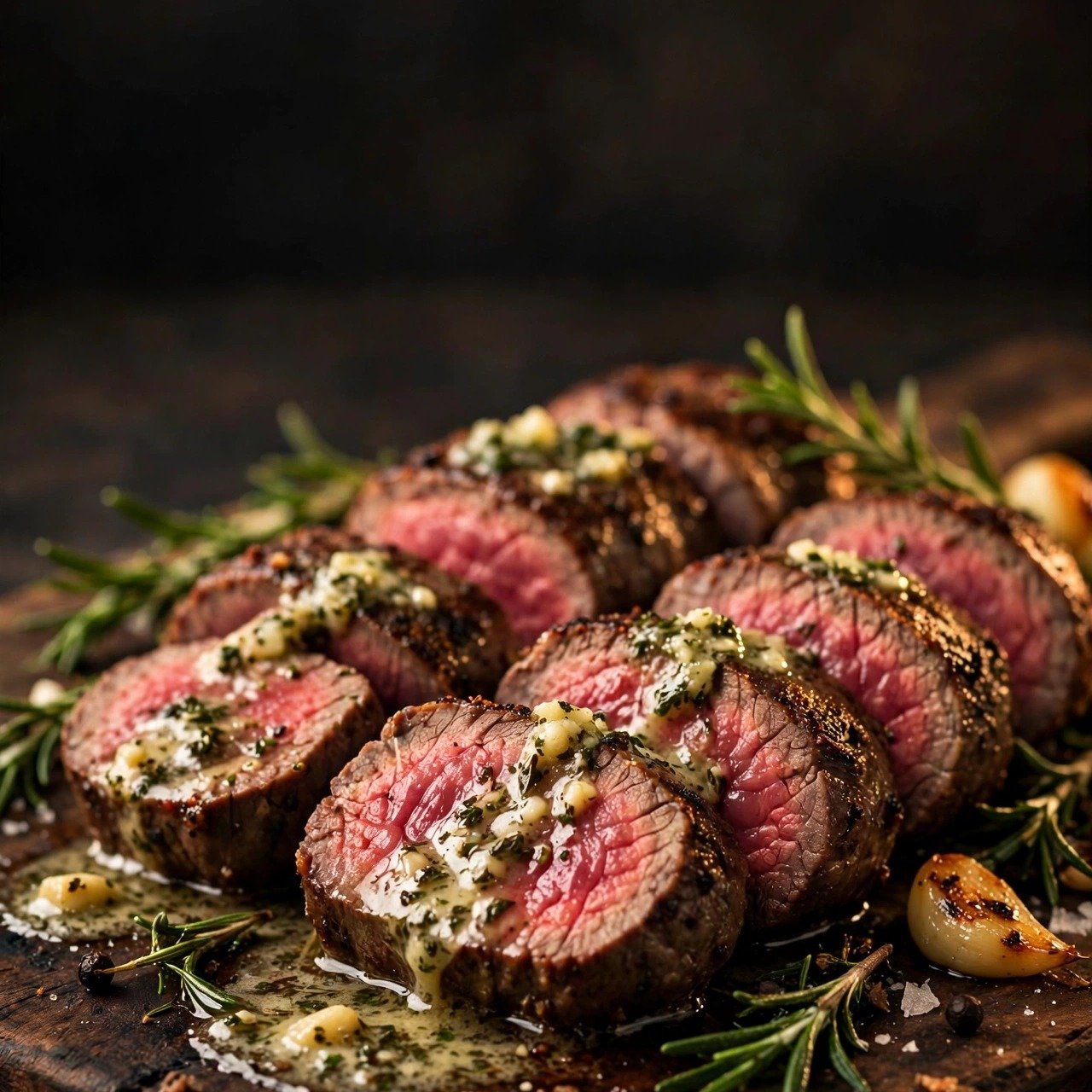
Every holiday season, the same video goes viral on TikTok: a whole beef tenderloin, rosy pink from edge to edge, hitting a screaming-hot cast iron skillet under garlic herb butter. Reverse searing flips roasting on its head — low heat first, then a fast sear — and turns the most expensive cut in the butcher case into one of the most forgiving.
Why You’ll Love This Reverse Sear Beef Tenderloin
High-heat roasting punishes tenderloin: at 450°F the outside overcooks before the center catches up, leaving a gray ring around a small pink core. Roasting low at 275°F warms the meat evenly, so the whole roast finishes at the same rosy temperature. The final sear is only about the crust — ninety seconds per side — so the inside never overcooks.
The method also buys you time. A four-pound tenderloin takes roughly 75 minutes to reach 120°F, and the temperature climbs slowly near the end. You can finish your sides and sear at the last minute.
Ingredients You’ll Need
For the roast: one whole beef tenderloin, trimmed, about 4 pounds; 1 tablespoon of kosher salt and 1 teaspoon of black pepper. For the sear: 2 tablespoons of avocado oil and 4 tablespoons of unsalted butter. For the garlic herb butter: 4 cloves of garlic, smashed; 2 sprigs of rosemary; 4 sprigs of thyme; and 1 tablespoon of chopped parsley.
You will also need a wire rack in a rimmed baking sheet, an instant-read thermometer, a large cast iron skillet, and butcher’s twine.
How to Make Reverse Sear Beef Tenderloin
- Dry-brine a day ahead. Pat the tenderloin dry. Fold the thin tail underneath and tie with twine every 2 inches so the roast is an even thickness. Season all over with salt and pepper, set it on the rack, and refrigerate uncovered for 24 hours. The salt draws moisture out, dissolves, and is pulled back in. The uncovered rest dries the surface, and a dry surface browns in seconds.
- Rest at room temperature. Set the roast on the counter 45 minutes before cooking.
- Roast low and slow. Heat the oven to 275°F. Roast until a thermometer in the thickest part reads 120°F for medium-rare, about 75 minutes for a 4-pound roast; start checking at 60 minutes. The surface will look pale — the color comes later.
- Rest before the sear. Tent loosely with foil and rest 15 minutes. The temperature rises a few degrees, and juices driven toward the center redistribute, so the first slice does not flood the cutting board.
- Sear hard and fast. Heat the cast iron over high heat until it just begins to smoke, about 3 minutes. Add the oil and sear 90 seconds per side until a deep mahogany crust forms. In the last minute, add the butter, garlic, rosemary, and thyme, then spoon the foaming butter over the roast for 30 to 45 seconds.
- Rest again and slice. Transfer to a cutting board and rest 10 minutes. Slice into 1/2-inch medallions against the grain and spoon any pan butter over the top.
5 Viral Reverse Sear Beef Tenderloin Recipes
These five variations keep the same low roast and hard sear, changing only the finishing flavors.
1. Classic Garlic Herb Butter
This is the version from the viral videos. Follow the base recipe exactly, adding the butter only in the final minute so it foams and browns without burning. The herbs perfume the butter and the garlic turns sweet.
2. Horseradish Cream
Whisk together 1/2 cup of sour cream, 3 tablespoons of prepared horseradish, 1 teaspoon of Dijon mustard, 1 teaspoon of lemon juice, and a pinch of salt. Make it while the roast is in the oven and chill until serving. Sear with butter and garlic but skip the herbs.
3. Red Wine Mushroom
While the roast rests, melt 2 tablespoons of butter in a skillet over medium-high heat and cook 8 ounces of sliced cremini mushrooms until deeply browned, about 6 minutes. Add 1 minced shallot and 2 cloves of garlic, then pour in 1/2 cup of dry red wine and scrape up the browned bits. Simmer until reduced by half, stir in 1/2 cup of beef broth, and simmer 3 minutes more.
4. Peppercorn Crusted
Crush 2 tablespoons of black peppercorns coarsely and mix with 1 tablespoon of kosher salt. Press the mixture firmly onto the tenderloin before the dry brine, then refrigerate uncovered overnight as usual. The pepper forms a crackling, spicy crust that regular ground pepper never achieves.
5. Chimichurri
Blend 1 cup of fresh parsley, 1/4 cup of oregano leaves, 3 cloves of garlic, 1/3 cup of olive oil, 2 tablespoons of red wine vinegar, 1/2 teaspoon of red pepper flakes, and 1/2 teaspoon of salt until just combined — a little chunky, not smooth. Make it an hour ahead so the flavors meld.
Tips for the Best Reverse Sear Beef Tenderloin Every Time
Tie the roast evenly. The top reason a tenderloin cooks unevenly is shape. The tail is half the thickness of the center, so without tying it will be well-done while the middle is still rare. Folding the tail under and tying every two inches fixes this.
Pull the roast early, not late. Carryover cooking adds 3 to 5 degrees during the rest, so pulling at 120°F lands at 123 to 125°F — a true medium-rare. If your guests prefer medium, pull at 130°F instead.
Get the pan hotter than feels polite. A lukewarm skillet causes a pale, steamed crust. The cast iron should be smoking lightly before the beef goes in, with an aggressive sizzle on contact.
Dry the surface again before searing. Even after a day uncovered in the fridge, blot the roast with paper towels right before it hits the pan. Surface moisture must boil off before browning can start.
Easy Variations
The method is not limited to tenderloin. It works on a prime rib roast, a strip loin, or thick ribeye steaks — just adjust the low-roast time to the thickness of the cut and keep the same pull temperatures. A 2-pound center-cut tenderloin roasts in about 45 minutes.
Storage and Reheating
Store leftover slices in an airtight container in the refrigerator for up to 3 days. Never blast leftovers in the microwave, which takes them from pink to gray in a minute. Warm slices gently in a 250°F oven for about 10 minutes, or eat them cold over a salad. Cooked tenderloin also freezes well for up to 2 months: wrap slices tightly in plastic wrap, then foil.
Frequently Asked Questions
How long does a 4-pound tenderloin take? About 75 minutes in a 275°F oven to reach 120°F, plus a 15-minute rest and about 6 minutes of searing. Budget roughly 2 hours from oven to table. Start checking at 60 minutes and trust the thermometer over the clock.
Can I do it ahead? Yes — roast up to 2 hours ahead and hold it loosely tented at room temperature. Sear just before serving; the hot skillet rewarms the outside while the center stays pink. Do not sear ahead and reheat later — the crust goes soft and the center overcooks.
What if I don’t have cast iron? A heavy stainless steel skillet is the next best choice; heat it until smoking and sear for the same 90 seconds per side. A nonstick pan will not work — it cannot take the heat needed for a proper crust. In a pinch, use a hot broiler, 2 to 3 minutes per side.
How do I know it’s done without a thermometer? You cannot know with confidence on a cut this expensive, and a thermometer is the best fifteen dollars you will spend on this meal. As a rough guide, medium-rare feels like the fleshy part of your palm when thumb and index finger touch — some give, but springy. Cut into the thickest part only as a last resort.
Why is my tenderloin gray instead of pink edge to edge? Almost always, the oven was too hot or the sear went too long. Roasting above 300°F builds a gray band under the surface, and searing more than 2 minutes per side cooks the outer layer past medium. Keep the oven at 275°F and pull at 120°F.
Nutrition Estimate
Per serving (about 6 ounces of cooked tenderloin with garlic herb butter), this recipe provides an estimated 480 calories, 38 grams of protein, 34 grams of fat, 1 gram of carbohydrates, and 620 milligrams of sodium. These values are an estimate only; actual nutrition varies with roast size and butter served.
The Bottom Line
Reverse searing takes the most intimidating roast on the holiday table and makes it the most reliable. Low heat does the careful work, a short rest settles the juices, and a ninety-second sear delivers the crust. Dry-brine a day ahead, pull at 120°F, get the pan smoking hot, and you will carve a roast that is pink from edge to edge.