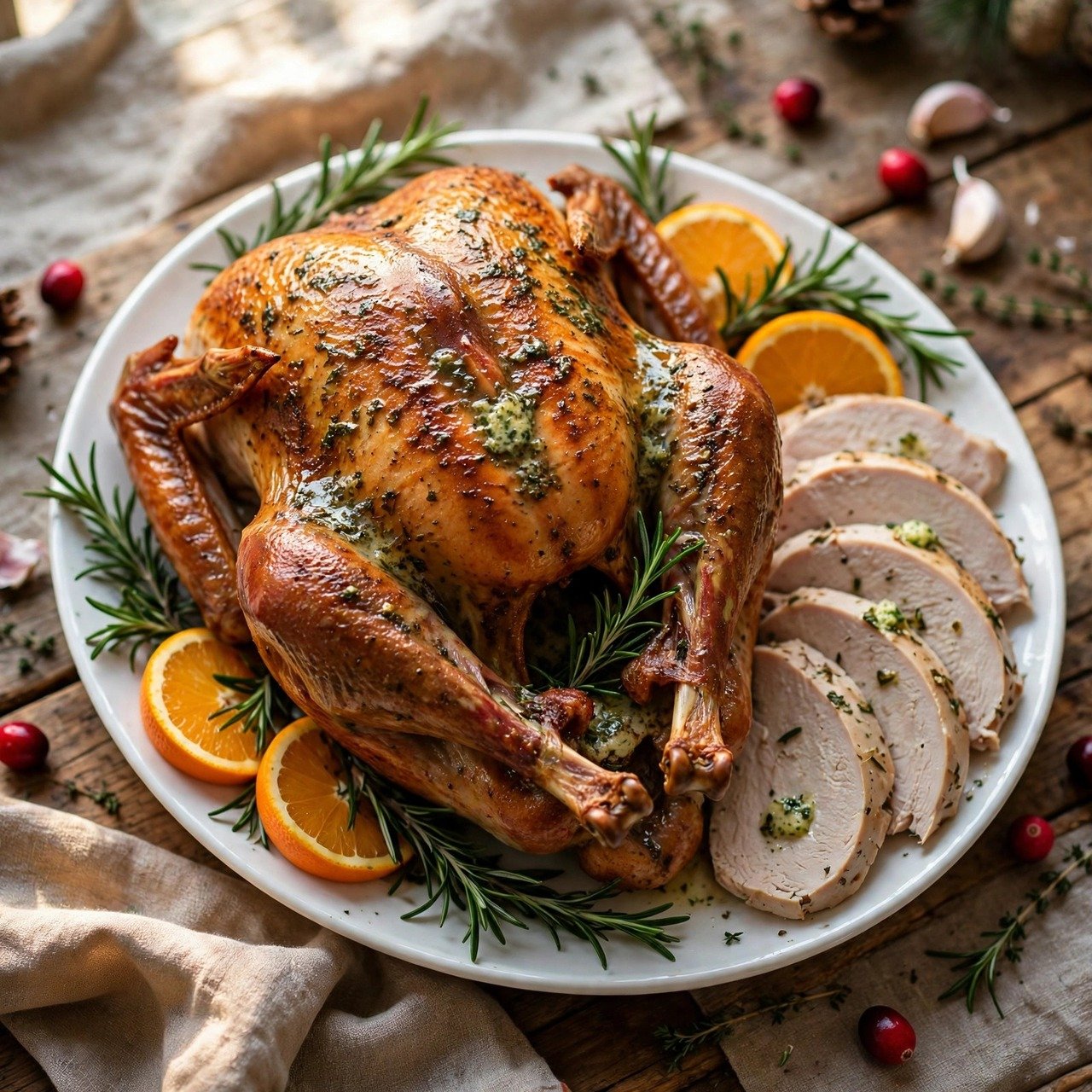
Why You’ll Love This Famous Thanksgiving Turkey
Every November one turkey takes over the internet, and this year it is Emmanuel Duverneau’s roast turkey, the golden, gravy-drenched bird that has passed 100 million views. The skin crackles, the meat stays juicy, and the pan gravy tastes restaurant-made.
This recipe gives you that same result, plus five ways to make it your own. The breast dries out fast while the legs need more time, so a hot start, a lower finish, a proper rest, and a gravy built from the drippings solve that split. All you need is a pan, a rack, and a thermometer.
Ingredients You’ll Need
Classic herb-butter roast with pan gravy, serving 10 to 12. Variations list only what changes.
- 1 whole turkey, 12 to 14 lb, thawed
- 1 cup (2 sticks) unsalted butter, softened
- 4 cloves garlic, minced; 2 tablespoons thyme
- 1 tablespoon each chopped rosemary and sage
- 1 tablespoon kosher salt; 1 teaspoon pepper; 1 teaspoon lemon zest
- 2 onions, quartered; 2 carrots and 2 celery stalks, chunked
- 1 head garlic, halved; 1 lemon, halved
- 4 cups low-sodium stock, divided
- 1/4 cup flour; 2 tablespoons chopped parsley
How to Make Famous Thanksgiving Turkey
Roast about 3 hours and 15 minutes, plus 30 minutes of resting.
- Heat the oven to 450°F. Pat the turkey dry inside and out; dry skin crisps instead of steaming pale. Season the cavity, then add half the onion, the lemon, and the garlic head.
- Mash the butter with the garlic, herbs, salt, pepper, and lemon zest. Loosen the breast skin, spread two-thirds of the butter underneath, and rub the rest outside. Butter under the skin bastes the breast from within.
- Scatter the remaining vegetables in a roasting pan and set a rack on top. Place the turkey breast-side up, tuck the wing tips under, and pour 1 cup of stock into the pan. The vegetables roast in the drippings and flavor the gravy.
- Roast at 450°F for 30 minutes until the skin turns golden. Reduce to 325°F and roast 2 hours and 30 to 45 minutes more. Tent the breast with foil if it browns too fast.
- The turkey is done when a thermometer reads 165°F in the thickest part of the thigh, clear of the bone, and 160°F in the breast; the breast climbs to 165°F as it rests. If the thigh reads low, roast 15 minutes more and check again.
- Move the turkey to a board, tent loosely with foil, and rest at least 30 minutes. Roasting drives moisture to the center, and slicing too soon lets it run onto the board. During the rest the fibers relax and moisture spreads back.
- While the turkey rests, strain the drippings and skim the fat, leaving 1/4 cup in the pan. Whisk in the flour and cook 2 minutes until nutty. Whisk in 3 cups of stock and the drippings, scraping the browned bits, and simmer 8 to 10 minutes until it coats a spoon.
- Remove the legs and thighs, then slice the breast across the grain in half-inch slices. Arrange on a warm platter with gravy and parsley over the top. Serve the rest of the gravy on the side.
Tips for the Best Famous Thanksgiving Turkey Every Time
Moisture is the enemy of crisp skin. Pat the bird dry, then leave it uncovered in the refrigerator overnight. Cold, dry air pulls moisture from the surface, giving you a shattering, golden crust.
The blast at 450°F sets and browns the skin quickly, then dropping to 325°F lets the breast and legs cook through without drying out. One steady temperature cannot do both jobs well.
Ovens run hot or cold, and turkeys vary in shape. The pop-up timer often triggers late, after the breast is already dry. Only a reading of 165°F in the thigh is reliable.
If the breast always dries out, shield it with foil once golden; the cover traps steam around the lean meat while the legs catch up. If the skin looks pale, raise the oven to 425°F for the final 15 minutes and skip the baste.
Lumps form when flour meets hot liquid too fast. Whisk the flour into the fat and cook it 2 minutes, then add the stock in a slow stream while whisking. If lumps still appear, strain the gravy.
Easy Variations
Each starts from the base method above.
1. Classic Herb-Butter Roast
This is the base recipe in full. Ingredients: the full list above. Follow all eight steps: 450°F for 30 minutes, then 325°F until the thigh reaches 165°F. Serve with pan gravy and parsley.
2. Spatchcock Turkey
Ingredients: same herb butter and vegetables, plus kitchen shears. Cut out the backbone, flip the bird breast-side up, and press the breastbone flat. Roast on a sheet pan at 425°F for 80 to 90 minutes, until the thigh hits 165°F. It finishes about an hour faster.
3. Dry-Brined Turkey
Ingredients: 3 tablespoons kosher salt, 1 tablespoon sugar, 1 teaspoon black pepper, and the herb butter. Two to three days ahead, rub the salt mixture all over and under the skin, then refrigerate uncovered. The salt draws moisture out, then dissolves and is pulled back in, seasoning the meat deeply. Skip extra salt.
4. Cajun-Spiced Turkey
Ingredients: 1/2 cup melted butter with 2 tablespoons Cajun seasoning, 1 tablespoon paprika, 1 teaspoon garlic powder, 1 teaspoon onion powder, and 1/2 teaspoon cayenne. Rub the spiced butter under and over the skin, stuff the cavity with onion, celery, and a halved orange, and roast as in the base method. Serve with gravy and hot sauce.
5. Citrus-Herb Turkey
Ingredients: the base herb butter, plus the zest and juice of 2 oranges, 1 tablespoon honey, and extra thyme. Whisk the orange zest, juice, and honey into the butter, stuff the cavity with citrus halves and thyme sprigs, and roast as in the base method.
Storage and Reheating
Cool leftovers within 2 hours, slice the meat off the bone, and refrigerate in airtight containers for up to 4 days. Keep dark and white meat separate, since they reheat at different speeds. Freeze sliced turkey with a little gravy or stock for up to 3 months, and thaw overnight in the refrigerator.
To reheat, place sliced turkey in a baking dish with a few tablespoons of stock or gravy, cover with foil, and warm in a 325°F oven for 20 to 25 minutes until it reaches 165°F. The steam keeps the meat from drying out. Leftover gravy keeps 4 days refrigerated and reheats in a small saucepan over medium-low heat.
Frequently Asked Questions
How long does thawing take? Allow 24 hours in the refrigerator for every 4 to 5 lb, so a 12 to 14 lb bird needs about 3 days. Never thaw on the counter, since the outside warms into the danger zone first.
Should I brine or dry-brine my turkey? Either works, but dry-brining is simpler and gives better skin. A wet brine adds water and can dilute flavor, while a dry brine seasons deeply and dries the skin. Give it two to three days for the best result.
Why is my turkey breast always dry? The breast is lean and overcooks easily at one high temperature. Butter under the skin, a two-stage roast, and a thermometer pulled at 160°F in the breast all help. Resting 30 minutes matters too.
Can I make the gravy ahead? Yes. Roast the neck, giblets, and vegetables a day ahead, simmer with stock for an hour, strain, and thicken with a flour-and-butter roux. On the day, whisk in the fresh drippings.
What size turkey do I need? Plan on 1 to 1 1/2 lb per person, which covers dinner plus leftovers. A 12 to 14 lb turkey serves 10 to 12 people. For more than 16 guests, roast two smaller birds, since large turkeys cook unevenly.
Nutrition Estimate
This is an estimate only, for a 6 oz serving of roasted turkey breast with skin and 1/4 cup of pan gravy, from standard nutrition data. Values vary with the bird’s size and how much skin and gravy you eat.
Per serving, the estimate is roughly 380 calories, 48 g protein, 16 g fat, 6 g carbohydrate, 1 g fiber, and 2 g sugar, with about 620 mg sodium. Turkey is high in protein and a good source of B vitamins, selenium, and zinc. To lighten the plate, skip the skin and keep the gravy modest. This is general information only, not medical or dietary advice.
The Bottom Line
A famous turkey is famous because the method respects the bird: dry skin, butter where it counts, a hot start and a gentle finish, a thermometer instead of a guess, and a real rest before carving. Learn those habits once and every turkey you make will be juicy and golden.