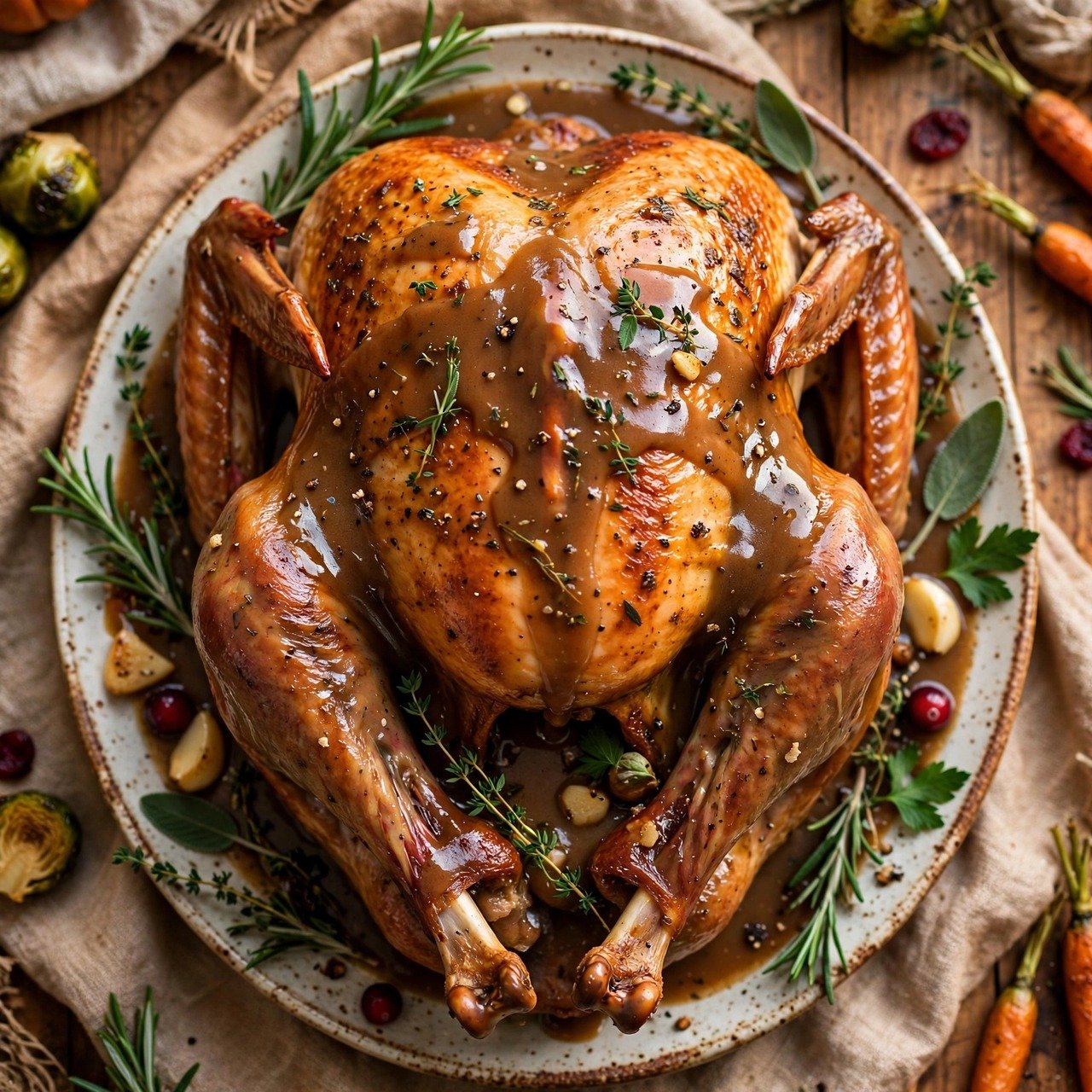
A dry turkey is the one Thanksgiving failure everyone remembers, and it is also the most avoidable. Gravy-braising fixes it at the source: instead of roasting the bird dry and pouring gravy over it at the table, you braise the turkey in the gravy itself. The bird cooks gently in seasoned stock, the meat stays moist all the way through, and the braising liquid reduces into a rich, glossy gravy that needs no last-minute rescue. Below is one base method plus five variations.
Why You’ll Love This Gravy-Braised Turkey
A whole turkey is a difficult piece of meat to roast well. The breast is lean and dries out fast, while the legs need more time. Gravy-braising solves that mismatch. The bird sits in a shallow bath of stock, wine, and aromatics, so the heat reaches the meat gently and evenly, and the liquid keeps the surface moist for the entire cook. The result is a turkey that slices juicy even at the breast, with skin that still turns golden in the final uncovered roast.
The second win is the gravy. Traditional gravy is a race against the clock after the bird comes out of the oven. Here the gravy builds itself while the turkey cooks: the drippings, the stock, and the vegetables in the pan reduce into a deeply flavored sauce, and all that is left at the end is a quick strain and a whisk.
Ingredients You’ll Need
This list makes one 12 to 14 pound turkey, serving 10 to 12 people. Scale the liquid up slightly for a larger bird.
- 1 whole turkey (12 to 14 lb), giblets and neck removed, patted dry
- 2 tablespoons kosher salt
- 1 tablespoon black pepper
- 4 tablespoons unsalted butter, softened
- 2 tablespoons olive oil
- 2 yellow onions, thickly sliced
- 4 carrots, cut into 2-inch pieces
- 4 celery stalks, cut into 2-inch pieces
- 1 head garlic, halved crosswise
- 4 cups low-sodium turkey or chicken stock
- 1 cup dry white wine
- 2 tablespoons all-purpose flour
- 4 sprigs fresh thyme
- 2 sprigs fresh rosemary
- 2 bay leaves
- Kitchen twine, for trussing
Use low-sodium stock: the braising liquid reduces by nearly half, and full-sodium stock turns salty as it concentrates.
How to Make Gravy-Braised Turkey
- Season the turkey the night before. Rub the bird inside and out with the salt and pepper, then refrigerate uncovered overnight.
- Preheat the oven to 325 degrees Fahrenheit. A moderate oven is the braising temperature: hot enough to cook the bird through, gentle enough that the liquid simmers rather than boils.
- Build the braising bed. Scatter the onions, carrots, celery, and garlic across the bottom of a large roasting pan. Pour in the stock and wine, then tuck in the thyme, rosemary, and bay leaves.
- Butter and truss the bird. Rub the softened butter all over the skin, then tie the legs with twine and tuck the wing tips behind the back.
- Braise covered for two and a half hours. Set the turkey breast-side up on the vegetables, cover the pan tightly with foil, and roast at 325 degrees Fahrenheit. The foil traps steam, so the bird effectively steams and braises at once.
- Uncover and brown for 45 to 60 minutes. Remove the foil, brush the skin with the pan juices, and raise the oven to 400 degrees Fahrenheit. Roast until the skin is deeply golden and a thermometer in the thickest part of the thigh reads 165 degrees Fahrenheit, and the breast reads at least 160 degrees.
- Rest for 25 to 30 minutes before carving. Move the turkey to a platter and tent loosely with foil. Resting lets the juices redistribute through the meat instead of running out onto the cutting board.
- Finish the gravy. While the turkey rests, strain the pan liquid into a saucepan, pressing the vegetables to extract every drop. Skim the fat from the surface, then whisk in the flour a little at a time over medium heat. Simmer for 5 to 8 minutes until the gravy coats the back of a spoon. Season with salt and pepper, and add a splash of the wine if it needs brightness.
1) Classic Gravy-Braised Turkey
This is the base recipe, and the version to make first. The white wine, thyme, and rosemary keep the gravy clean and savory, letting the turkey itself be the star. Serve with mashed potatoes, stuffing, and cranberry sauce, and pass the gravy generously.
2) Garlic Herb Butter
For a richer, more aromatic bird, mash 6 minced garlic cloves, 1 tablespoon of chopped sage, and 1 tablespoon of chopped rosemary into the butter before rubbing it on. Add a whole head of garlic, halved, to the braising vegetables.
3) Smoky Chipotle
For a turkey with a gentle Southwestern kick, stir 2 minced chipotle peppers in adobo and 1 teaspoon of smoked paprika into the stock before braising. Replace the white wine with a dark Mexican lager.
4) Maple Dijon
For a sweet-savory holiday bird, whisk 1/3 cup of pure maple syrup and 3 tablespoons of Dijon mustard into the braising liquid. In the final 20 minutes of uncovered roasting, brush the skin with a little extra maple syrup. The sugars caramelize into a glossy, mahogany glaze, while the mustard keeps the sweetness in check.
5) Mushroom Marsala
For the most luxurious version, add 8 ounces of sliced cremini mushrooms to the braising vegetables and replace the white wine with 1 cup of dry Marsala. The mushrooms collapse into the gravy, giving it an earthy, almost meaty richness.
Tips for the Best Gravy-Braised Turkey Every Time
Do not skip the overnight salt. It is the difference between seasoned meat and a bird that tastes bland beneath the skin. If you forgot, salt at least 4 hours ahead and leave the turkey uncovered in the fridge.
Trust the thermometer, not the clock. Ovens vary, and a 14-pound bird can finish anywhere from 3 hours 15 minutes to 4 hours total. The thigh must read 165 degrees Fahrenheit, and the breast should reach at least 160 degrees before resting; carryover cooking brings it the rest of the way.
Keep the liquid at a simmer, never a rolling boil. If the braise boils hard, the breast fibers contract and squeeze out moisture, undoing the whole point of the method. If your oven runs hot, drop the temperature to 300 degrees and add 20 minutes.
Easy Variations
Swap the white wine for apple cider for a fruitier gravy that pairs with pork-style sides. Add a sliced orange and a cinnamon stick to the braising liquid for a warm, spiced version.
Storage and Reheating
Cool leftovers within two hours, then refrigerate sliced turkey in an airtight container with a ladle of gravy poured over it for up to 4 days. The gravy keeps the meat moist during storage. To reheat, warm the slices gently in a covered dish with extra gravy at 325 degrees Fahrenheit for 15 to 20 minutes, until steaming. Avoid the microwave, which dries the breast quickly.
Frequently Asked Questions
Will the skin get crispy if the turkey braises in liquid? Yes, because the final uncovered roast at 400 degrees Fahrenheit dries and crisps the skin. The overnight uncovered rest in the fridge also helps. The skin will not be as shatteringly crisp as a high-heat roast, but it will be golden, crackly, and delicious.
Can I use a frozen turkey? Thaw it completely first, allowing about 24 hours in the fridge for every 4 to 5 pounds. Never braise a partially frozen bird: the outside overcooks while the inside stays underdone.
What if my roasting pan is too small? Use a large, deep roasting pan or a disposable foil roaster set inside a sheet pan for support.
Can I make the gravy ahead? Yes. Braise the turkey the day before, strain and finish the gravy, and refrigerate both separately. Reheat the gravy gently and roast the turkey briefly at 400 degrees Fahrenheit to re-crisp the skin before serving.
Why is my gravy thin? It likely needs more reduction. Simmer it uncovered for a few extra minutes, whisking, until it coats a spoon. If you are in a hurry, whisk 1 tablespoon of cornstarch with 2 tablespoons of cold water and stir it in, simmering for 2 minutes to thicken.
Nutrition Estimate
These values are an estimate only, for one serving of about 6 ounces of turkey with 1/4 cup of gravy. Actual numbers will vary. One serving contains approximately 380 calories, 46 grams of protein, 16 grams of fat, 4 grams of carbohydrates, and 640 milligrams of sodium.
The Bottom Line
Gravy-braised turkey is the holiday method for cooks who refuse to gamble dinner on a dry bird. The braise keeps the meat juicy, builds the gravy while the turkey cooks, and forgives a late table.