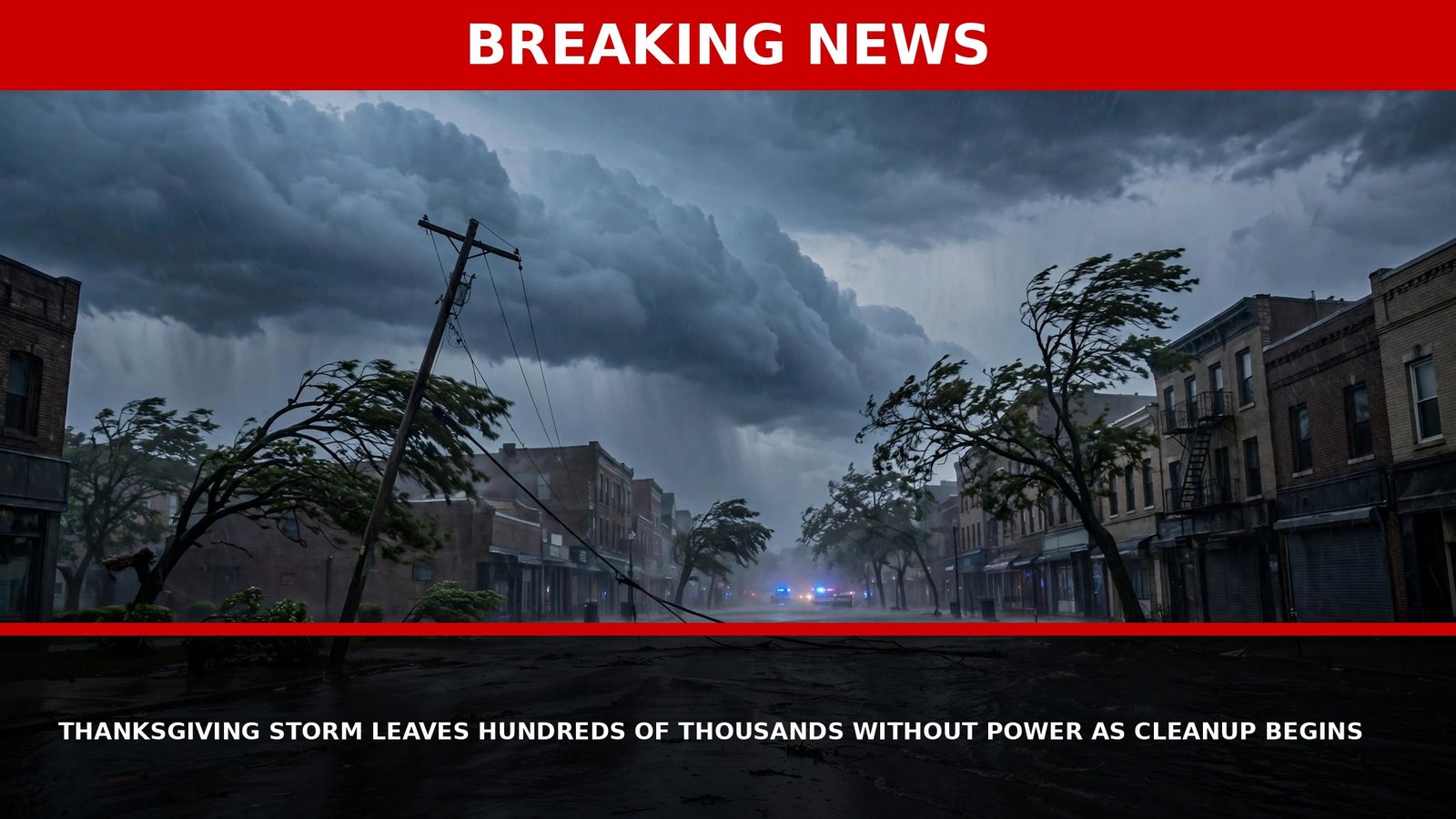
A powerful storm that battered the US East Coast on Thanksgiving Day knocked out power to nearly a million customers at its peak, and hundreds of thousands of homes and businesses were still in the dark on Friday as crews worked to restore electricity and communities began cleaning up.
Wind gusts of up to 70 mph toppled trees and power lines from New Hampshire to North Carolina, while heavy rain and king tides caused major coastal flooding. At the storm’s worst on Thursday evening, more than 900,000 customers had no power, according to PowerOutage.us. By Friday evening, that number had fallen to about 264,000 as repair crews made progress.
Where the outages hit hardest
Pennsylvania had the most customers still without power on Friday, with about 122,000 outages, followed by Missouri with around 72,000. New York had roughly 45,000 customers still waiting for power to return.
The storm stretched far beyond the East Coast. In Missouri, it dumped as much as 15 inches of snow on the eastern part of the state, and St. Louis recorded its largest November snowstorm in 46 years. The weight of the snow brought down branches and power lines, pushing peak outages in Missouri past 150,000 customers.
In Maryland, power outages at two water treatment plants led officials to ask 1.9 million residents in Montgomery and Prince George’s counties to immediately conserve water. The restriction was lifted early Friday.
Record flooding along the coast
At least 30 locations across Virginia, Maryland, Delaware and New Jersey experienced major flooding, according to the National Weather Service, with some gauges reaching all-time highs and surpassing the levels set during Superstorm Sandy by 1.5 feet or more.
Strong onshore winds combined with king tides to flood low-lying communities along the coast. Water rescues were reported in multiple states, from New York to Virginia, and the Commodore Barry Bridge between Pennsylvania and New Jersey was closed by wind damage and is expected to stay shut until at least Saturday.
The storm also forced the first weather postponement in the 100-year history of the Macy’s Thanksgiving Day Parade, which was rescheduled to Saturday morning.
Travel still disrupted
The storm hit during one of the busiest travel periods of the year, when around 80 million people were expected to travel for the holiday. FlightAware counted 454 cancellations and more than 2,400 delays across the country on Thursday, and about 1,600 delays and more than 500 cancellations were still being reported on Friday.
More rough weather is on the way for the trip home. Another round of storms is expected to bring snow to the Rockies on Friday night and soaking rain across the Plains on Saturday, carrying into Sunday — typically the busiest travel day of the year, when the TSA expects more than 3 million people to pass through airport checkpoints.
Why it matters
For many families, Thanksgiving itself was disrupted — some ate their holiday dinners by candlelight as the power went out, and hundreds of thousands spent Friday waiting for crews to reach their streets. The storm also exposed how much damage a single system can do when it combines high winds, heavy rain, snow and high tides across half the country at once.
The National Weather Service said the storm would slowly exit to the northeast, bringing lingering showers and isolated freezing precipitation through Saturday, but warned that “this huge system will take some time to weaken.”
What happens next
Utility crews are continuing restoration work across the East Coast and the Midwest, with Pennsylvania and New Jersey — which still had about 245,000 combined outages late Friday morning — the focus of the remaining effort. Travellers heading home this weekend should expect delays from the next round of storms, and coastal communities are still clearing flooded roads as water levels fall.
Featured image: AI-generated news illustration for Apkwonders News, headline matches this article. Sources: reporting verified November 28, 2026, including Al Jazeera, Reuters, CNN and Dawn.