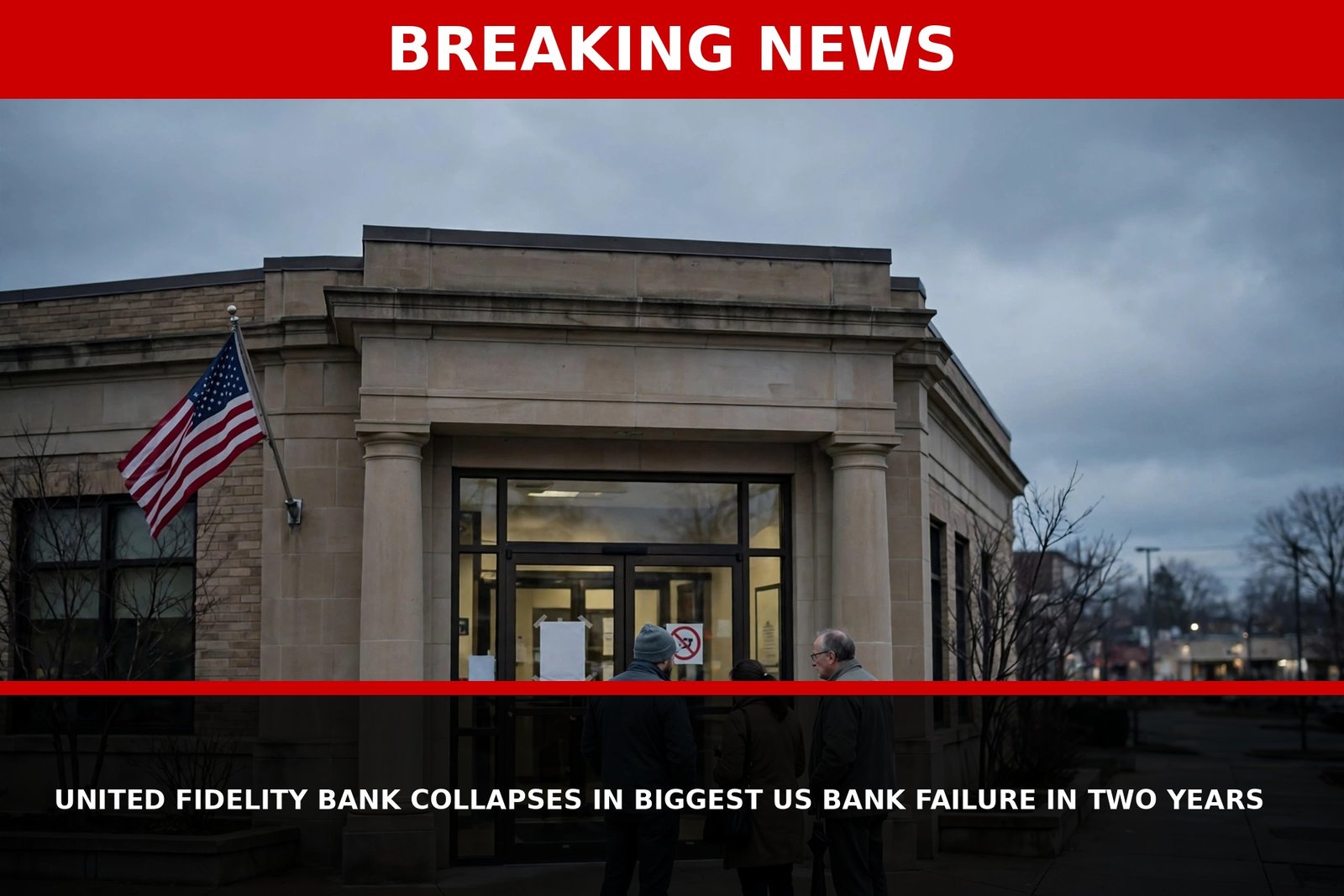
Federal regulators shut down United Fidelity Bank of Evansville, Indiana, on Friday, November 27 — the biggest US bank failure in more than two years — and arranged for First Citizens Bank to take over its deposits and branches.
The Office of the Comptroller of the Currency closed the bank and appointed the Federal Deposit Insurance Corporation (FDIC) as receiver, saying United Fidelity was in an “unsafe or unsound condition” and was likely unable to pay its obligations or meet depositor demands. The FDIC immediately struck a purchase-and-assumption agreement with First-Citizens Bank & Trust Company of Raleigh, North Carolina.
The deal
- $5.9 billion in assets and $5.4 billion in deposits at United Fidelity as of September 30, 2026.
- First Citizens assumes about $4.5 billion in deposits and $3.1 billion in loans.
- $2.6 billion asset discount in First Citizens’ winning bid — roughly 44 cents off every dollar of loans acquired — and no premium paid for the deposits.
- $1.83 billion estimated cost to the FDIC’s Deposit Insurance Fund, a 31% loss on the bank’s assets — an unusually high loss ratio for a failure of this size.
Depositors of United Fidelity automatically become depositors of First Citizens and keep all of their funds and deposit insurance coverage, the FDIC said. No action is required. The bank’s 22 branches across Indiana, Illinois, Florida, Colorado and the US Virgin Islands — where it operated as Bank of St. Croix — reopen as First Citizens branches starting Saturday, November 28.
Why it matters
United Fidelity is the largest US bank failure since Republic First Bank of Philadelphia, with about $6 billion in assets, closed in April 2024, and the second-largest since the 2023 regional banking crisis that took down Silicon Valley Bank and First Republic. It is the seventh US bank failure of 2026, up from two in each of 2024 and 2025.
The size of the FDIC’s loss is what stands out. The Deposit Insurance Fund held $163.5 billion at a 1.50% reserve ratio as of the third quarter of 2026, according to the FDIC’s Quarterly Banking Profile published November 24. A single failure wiping out more than 1.1% of that buffer narrows the room for the next one — and the 31% loss rate signals that the bank’s loan book was in far worse shape than its balance sheet suggested, which is why the buyer demanded such a steep discount.
Regulators have not given a specific cause for the failure. The OCC said only that the bank was in an “unsafe or unsound condition.” In its November report, the FDIC said the industry “faces weakness in certain loan portfolios and elevated unrealized losses,” calling these matters of “ongoing supervisory attention.”
What happens next
First Citizens — the same franchise that absorbed Silicon Valley Bank in 2023 — takes over the branches and accounts this weekend. The FDIC’s $1.83 billion loss estimate will be refined as the receiver works through United Fidelity’s loan book. Markets will be watching Monday for any reaction in regional bank shares, and for whether regulators signal that more lenders are under strain.
For customers, the message from regulators is simple: insured money is safe, accounts have moved to First Citizens, and branches reopen under the new name.
Featured image: AI-generated news illustration for Apkwonders News, headline matches this article. Sources: reporting verified November 28, 2026, including CNN, FDIC press release and Bloomberg Law.