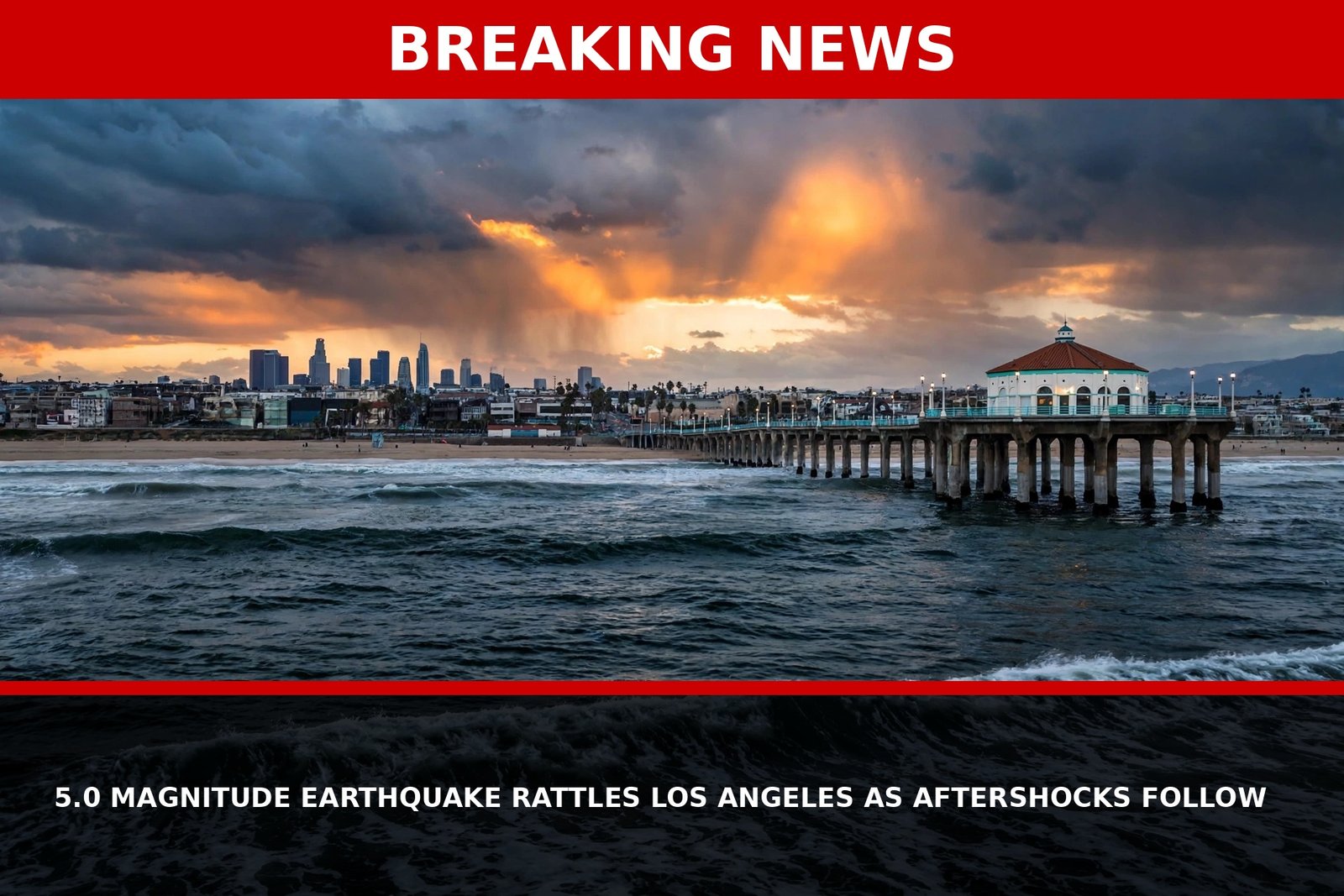
A magnitude 5.0 earthquake struck off the coast of Manhattan Beach on Saturday morning, November 28, rattling Los Angeles during the Thanksgiving holiday weekend and setting off a swarm of aftershocks, including a magnitude 4.5 tremor nearly two hours later. No injuries or major structural damage were reported, but the shaking — the strongest in the Los Angeles area in more than a decade — was felt by millions across Southern California.
According to the U.S. Geological Survey, the quake hit at 9:30 a.m. PT, about 3.7 miles west-southwest of Manhattan Beach at a depth of about 7.6 miles. The agency first reported the quake at magnitude 5.2, briefly downgraded it to 4.7, and then reassessed it at 5.0. The USGS estimated that about 15.84 million people felt the initial shaking, with nearly 6 million feeling light to strong shaking.
The aftershocks began almost immediately. A magnitude 3.0 quake struck near Hermosa Beach at 9:34 a.m., followed seconds later by a magnitude 2.5 tremor, then a magnitude 3.7 at 10:01 a.m. The strongest aftershock, a preliminary magnitude 4.5, hit at 11:41 a.m. PT and was felt in Redondo Beach, where car alarms went off in a grocery store parking lot. The USGS estimated a 30 percent chance of an aftershock of magnitude 4.0 or greater.
Shaking at LAX and along the coast
At Los Angeles International Airport, ceiling tiles fell inside a terminal as alarms rang out, and people briefly ducked under tables. An air traffic controller felt the strong tremors and told pilots approaching the runway to go around. In Santa Monica, people ran out of stores as buildings rattled loudly and trees swayed, and shaking was felt as far away as Pasadena, about 27 miles northeast of the epicenter.
Shortly after the quake, flames and smoke were seen rising over the Chevron refinery in El Segundo, about three miles from Manhattan Beach. The city said the refinery was experiencing a “contingency flaring incident” and that firefighters from El Segundo and Manhattan Beach were responding, adding there was no public threat. The city of Manhattan Beach closed its famous pier “out of an abundance of caution.” The U.S. National Tsunami Warning Center said the earthquakes posed no tsunami threat.
Biggest Los Angeles quake since 2014
Seismologist Lucy Jones, a faculty associate in geophysics at the California Institute of Technology, said the quake was “one of the larger ones we’ve had in the Los Angeles area in quite a while,” adding that the 2014 La Habra earthquake — a magnitude 5.1 centered near Brea in Orange County — was the last time the region broke magnitude five. Allen Husker, manager of the Southern California Seismic Network, said shaking and damage were less than they might have been because this quake was deep and offshore. USGS seismologist Elizabeth Cochran said the depth of about 12 kilometers gave the seismic waves farther to travel to the surface, keeping shaking levels lower.
The quake did not come out of nowhere. Jones said three earthquakes of about magnitude 3 had struck off the coast in the past week, including one near the same spot by Manhattan Beach that she said would be considered a foreshock.
City response
The Los Angeles Fire Department went into “earthquake mode” shortly after the shaking, deploying personnel from all 106 neighborhood fire stations to survey critical infrastructure across the city’s 470-square-mile jurisdiction. By 10:40 a.m. PT, the department had completed its initial response, reporting no significant structural damage or injuries. After the 4.5 aftershock, it returned to earthquake mode and again reported no injuries or damage.
Los Angeles Mayor Karen Bass told CNN that residents should prepare for potential aftershocks, though there were no warnings for travel. “Remember that we experience earthquakes here all the time,” she said. “Again, this one was more significant and closer to Los Angeles, but there’s no reason for people not to continue with their normal activity.”
Why it matters
Saturday’s quake was a reminder that the Los Angeles basin sits on a dense web of faults, and that a moderate offshore quake can still be felt by nearly 16 million people. The city was spared the worst because the quake struck offshore and at depth — but experts warn aftershocks can continue for days or weeks, and Caltech said the sequence near Manhattan Beach was still continuing hours after the first jolt.
What happens next
The USGS and Caltech are continuing to monitor the sequence, and the magnitudes of the events may change as they are reviewed and more data becomes available. Residents are urged to stay alert and be prepared for aftershocks — to “Drop, Cover, Hold On” if shaking resumes, protecting their heads and necks under sturdy furniture or near an interior wall, away from windows and doorways.
Featured image: AI-generated news illustration for Apkwonders News. Sources: reporting verified November 29, 2026, including CNN, USA TODAY, KTLA, Associated Press and New York Post.