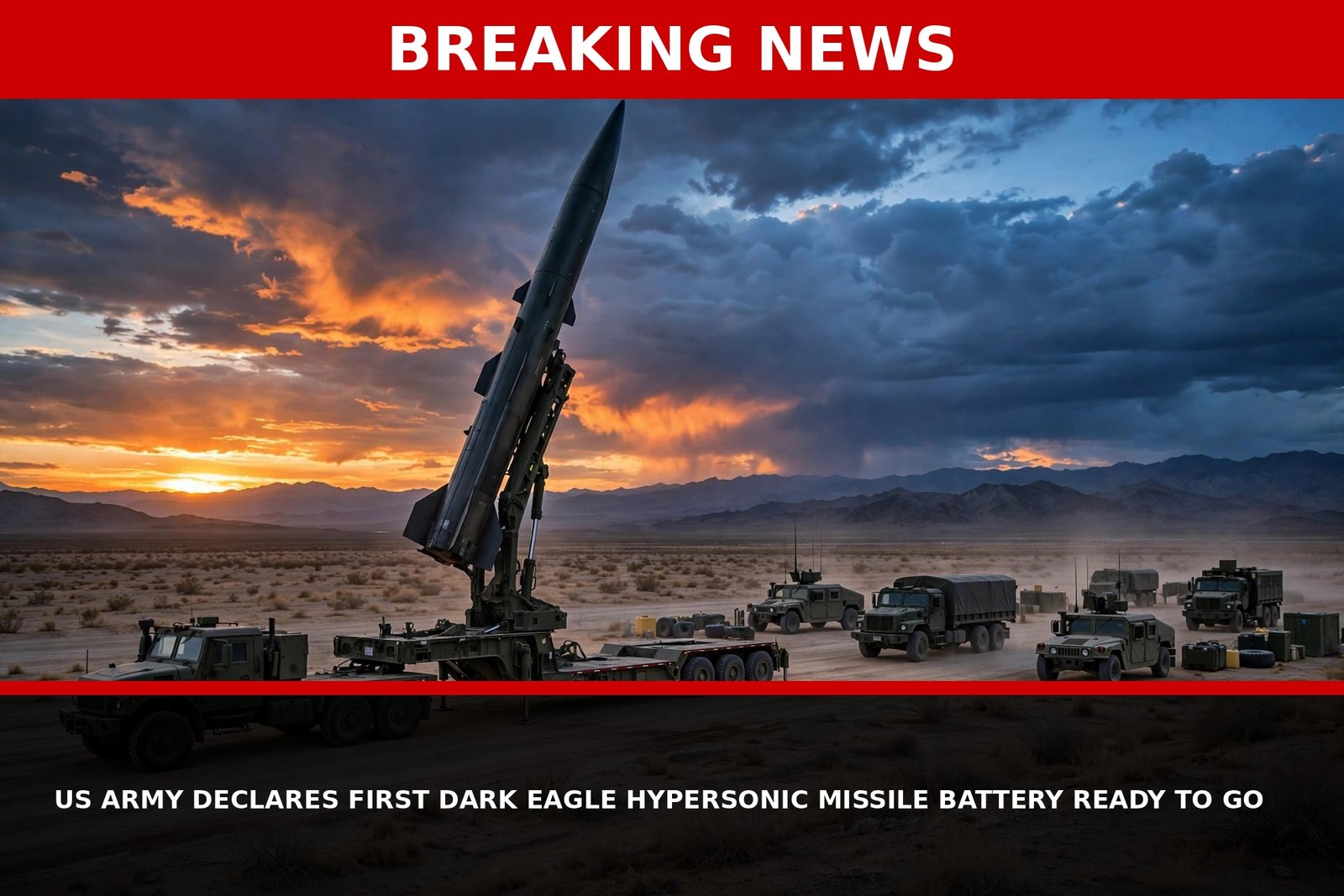
The U.S. Army says its first Dark Eagle long-range hypersonic missile battery is fully fielded and “ready to go,” the general in charge of the program told a defense publication — nearly three years after the weapon was originally supposed to reach soldiers.
“It is fully fielded. It is ready to go,” Lt. Gen. Frank Lozano, the Army’s program acquisition executive for fires, told Breaking Defense in an interview conducted on November 19 and published on November 25. “It is a global deployable and employable warfighting capability,” he added.
The announcement marks a milestone for a program that has been delayed again and again since it was launched, and it puts the Army into a club that, until now, belonged almost entirely to China and Russia: ground forces able to fire a conventional hypersonic weapon at targets more than a thousand miles away.
What Dark Eagle is
Dark Eagle is the Army’s name for the Long-Range Hypersonic Weapon (LRHW), a ground-launched boost-glide missile. A rocket booster carries the weapon to the edge of space, then releases an unpowered glide body that steers itself toward its target at more than five times the speed of sound, following an unpredictable path that makes it far harder to intercept than a traditional ballistic missile.
According to publicly reported figures, the missile can fly at about 3,800 miles per hour and strike targets up to 1,725 miles (2,775 kilometers) away. A single battery consists of four trailer-mounted launchers, each carrying two missiles, for a total of eight ready rounds, plus a battery operations center and support vehicles.
The weapon carries only conventional, non-nuclear warheads, the Pentagon has said. It shares its Common Hypersonic Glide Body with the Navy’s Conventional Prompt Strike program, so the fielding extends a joint hypersonic effort rather than a standalone Army project.
The system has been exercised at Joint Base Lewis-McChord in Washington state, home to the Army’s Multi-Domain Task Forces — formations built to operate across land, air, sea, space and cyber in contested environments. The Army has not publicly confirmed the exact location of the first fully fielded battery.
Three years late
The road to this point has been long. The Army originally planned to field the first Dark Eagle battery in 2023, but testing problems — including a mechanical engineering issue with the launcher — pushed the date back repeatedly.
Production ran into trouble too. A July 2026 report from the Government Accountability Office identified problems at Lockheed Martin facilities, including shortcomings in manufacturing standards and quality control, and the Army and Navy temporarily suspended production to address issues found during testing.
That history is why the Army’s declaration is being read as a turning point rather than a routine update — and why it comes with caveats. Lozano declined to clarify whether a Bloomberg report last month claiming the battery had yet to be fielded was accurate, and the Army has not disclosed exactly when the milestone was reached. Some reporting also notes that no live missile launches were conducted during the exercise in which the battery was declared ready.
Why it matters
Hypersonic weapons have become one of the most closely watched arms races of the decade. Russia has used hypersonic missiles in Ukraine, and China has fielded its own systems — while the United States, despite spending billions, had no operational ground-launched hypersonic weapon in service until now.
For the Army, Dark Eagle fills a gap at the top of its long-range fires portfolio, sitting above the Precision Strike Missile and the Typhon mid-range capability. It gives ground commanders a weapon that can hit high-value, heavily defended targets — air defenses, command posts, missile launchers — deep inside enemy territory, on timelines measured in minutes rather than hours.
The timing also matters politically. The announcement lands as the administration pushes a major military expansion, including the Golden Dome missile-defense program, and as Congress debates funding for the next round of weapons programs.
What happens next
The Army is already working on its second and third Dark Eagle batteries. Lozano said production of the third battery has passed the halfway point, though he declined to give timelines for when the next units will be ready, citing operational security.
The Pentagon’s objective is to complete the rapid fielding phase by fiscal year 2028, with further operational assessments and test launches planned along the way. The October 2025 approval of the program’s master test strategy by the Pentagon’s testing office set the framework for those assessments.
Watch for the first confirmed live-fire test of a fielded battery, for any disclosure of where the first battery is deployed, and for how quickly the second and third batteries follow — those are the steps that will turn a declaration of readiness into a proven capability.
Featured image: AI-generated news illustration for Apkwonders News. Sources: reporting verified November 29, 2026, including New York Post, Army Recognition and Defence Talks.