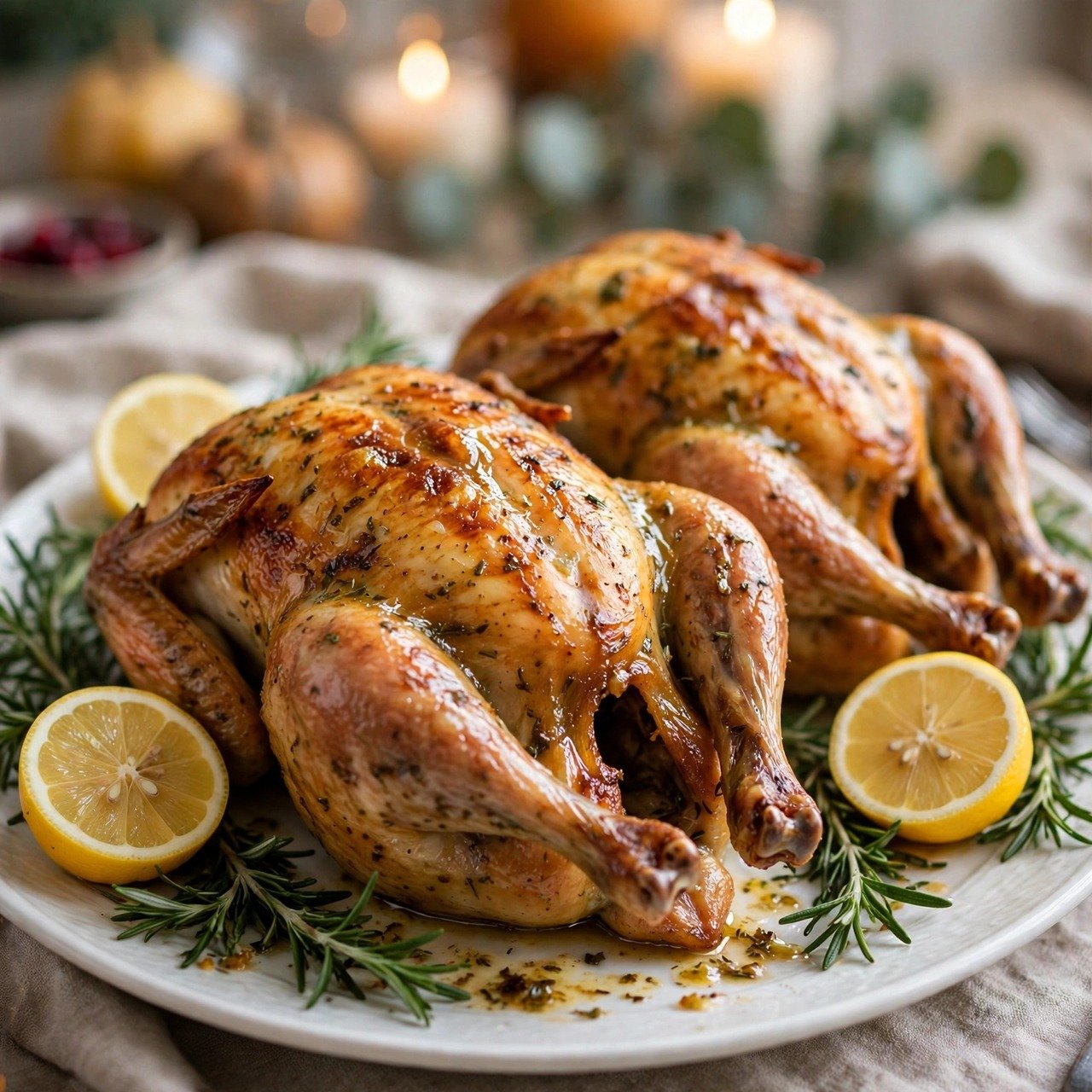
Setting a whole roasted bird in front of each guest turns an ordinary holiday table into a restaurant-style dinner. Cornish hens do that with about twenty minutes of hands-on work. They roast far faster than a turkey, and herb butter under the skin bastes the meat from the inside out. Below is one base method plus five variations.
Why You’ll Love These Herb Butter Cornish Hens
Cornish hens are the small-table answer to the big-bird problem. A Cornish hen weighs about one and a quarter to one and a half pounds, one generous serving, and roasts in fifty to sixty minutes. Everyone gets crispy skin, a drumstick, and a breast.
The herb butter is what makes it work. Plain roasted hens can taste lean and dry. Butter under the skin puts fat against the breast, so the meat bastes itself as it roasts. The herbs infuse into that fat, so flavor reaches every bite. Brushed outside, it gives the skin its golden color and crisp texture.
These hens are forgiving. If one bird finishes early, pull it out to rest while the others catch up. For a small Thanksgiving or a Friendsgiving, this is the recipe to learn.
Ingredients You’ll Need
This list makes four hens. Halve it for two, or use two pans for six.
- 4 Cornish hens (1 1/4 to 1 1/2 lb each), giblets removed
- 8 tablespoons unsalted butter, softened
- 4 garlic cloves, minced
- 1 tablespoon fresh rosemary, chopped
- 1 tablespoon fresh thyme leaves
- 1 teaspoon lemon zest
- 1 1/2 teaspoons kosher salt
- 1/2 teaspoon black pepper
- 1 tablespoon olive oil
- 1 lemon, halved
- 1 head garlic, halved crosswise
- Rosemary and thyme sprigs, for the cavities
- Kitchen twine, for trussing
- 1 cup low-sodium chicken broth, for the pan
Use unsalted butter, fully softened: cold butter tears the skin, melted butter runs off. Fresh herbs are worth it; dried rosemary tastes woody and sharp.
How to Make Herb Butter Cornish Hens
- Bring the hens to room temperature. Take them out thirty to forty-five minutes before roasting. Cold birds cook unevenly and steam instead of crisping. Pat each hen very dry inside and out. Dry skin is the key to crisp skin.
- Preheat the oven to 425 degrees Fahrenheit. This crisps the skin without burning the butter. Pour the broth into a roasting pan; it keeps the drippings from scorching.
- Make the herb butter. Mash the softened butter with the garlic, rosemary, thyme, lemon zest, salt, and pepper until evenly mixed.
- Butter under the skin. Loosen the breast skin from the neck end without tearing it. Spread a quarter of the butter under the skin, over the breast and thighs, then rub the rest over the outside. The fat slows heat transfer, keeping the lean breast juicy while the legs cook through.
- Season and stuff the cavities. Squeeze half a lemon into each cavity, then tuck it inside with a sprig each of rosemary and thyme and a few pieces of garlic.
- Truss the hens. Tie the legs with twine and tuck the wing tips behind the back. Trussing keeps the legs tucked so the breast cooks evenly and the legs do not overcook.
- Roast for fifty to sixty minutes. Place the hens breast-side up, an inch apart. Roast at 425 degrees Fahrenheit until the skin is deeply golden and a thermometer in the thickest part of the thigh reads 165 degrees Fahrenheit. If the skin browns too fast after thirty minutes, tent with foil.
- Baste once, halfway through. At about thirty minutes, spoon pan juices over each bird. One baste adds color and flavor; more drops the oven temperature.
- Rest for ten minutes before serving. Move the hens to a platter, tent loosely with foil, and rest for ten minutes. Cutting too soon lets the juices run out; resting lets them redistribute.
1) Classic Garlic Herb Butter
This is the base recipe, and the version to make first. Garlic, rosemary, and thyme are the classic trio for roast poultry because they hold up to high heat without turning bitter. Serve with mashed potatoes and roasted carrots.
2) Lemon Rosemary
For a brighter, Mediterranean take, double the lemon zest to two teaspoons and add one tablespoon of lemon juice to the butter. Add two extra sprigs of rosemary to each cavity, and replace the broth with half a cup of white wine mixed with half a cup of broth. The wine’s acidity cuts the butter’s richness.
3) Honey Dijon Glaze
Hold back one tablespoon of the herb butter. In the last fifteen minutes, brush each hen with a glaze of three tablespoons of honey, two tablespoons of Dijon mustard, and that reserved butter, melted together. The honey caramelizes into a lacquered, mahogany shine, while the mustard keeps it from tasting too sweet. Watch closely: honey burns quickly at 425 degrees.
4) Cajun Spiced
For a smoky, spicy bird, stir one and a half teaspoons of Cajun seasoning, half a teaspoon of smoked paprika, and a quarter teaspoon of cayenne into the butter, and cut the rosemary to two teaspoons. Swap the lemon in the cavity for a quartered lime. The spice crust darkens fast, so check at forty minutes and tent with foil if the skin is already deep brown.
5) Cranberry Orange Glaze
Make the base butter with orange zest instead of lemon zest, and stuff each cavity with an orange quarter. In the last fifteen minutes, brush the hens with a glaze of half a cup of cranberry sauce thinned with two tablespoons of orange juice and one tablespoon of honey, warmed until pourable. The glaze sets into a glossy, ruby-red coat, and the tart cranberry balances the rich butter.
Tips for the Best Herb Butter Cornish Hens Every Time
Dry the skin twice: once out of the package, and again right before buttering. Even a thin film of moisture steams the skin, and steamed skin rarely crisps fully.
Trust the thermometer, not the clock. The only reliable sign of doneness is 165 degrees Fahrenheit in the thickest part of the thigh.
Keep the small birds from drying out by checking early. The breast can pass from perfect to dry in minutes, so start checking at forty-five minutes. Pull the birds the moment the thigh hits 165 degrees; the rest adds three to five degrees through carryover cooking.
Easy Variations
Swap the herbs for sage and marjoram in the fall, or tarragon and chives in the spring. Add a tablespoon of maple syrup to the butter for a sweet-savory bird that pairs with roasted squash.
Storage and Reheating
Cool leftovers completely, then refrigerate in an airtight container for up to three days. To reheat, place a hen in a baking dish with two tablespoons of chicken broth, cover tightly with foil, and warm in a 325 degree Fahrenheit oven for fifteen to twenty minutes, until it reaches 165 degrees Fahrenheit.
Frequently Asked Questions
What is a Cornish hen, exactly? A Cornish hen, also sold as a Cornish game hen, is a young chicken, usually a Cornish and White Rock cross, harvested at about four to five weeks old. Each bird weighs roughly one and a quarter to one and a half pounds and serves one person.
Can I cook Cornish hens from frozen? You can, but thawed is much better. A frozen hen roasts unevenly and the skin will not crisp. Thaw in the refrigerator for twenty-four hours, or in cold water for about two hours.
Do I need to truss the hens? Trussing is recommended but not required. It keeps the legs tucked in so they cook evenly. If you skip it, the drumsticks may brown faster; tent with foil if needed.
What should I serve with Cornish hens? Anything you would serve with roast chicken: mashed potatoes, roasted root vegetables, green beans almondine, or wild rice. Because each guest gets their own bird, the sides can be simpler; the hen is the centerpiece.
Can I make these ahead of time? Prep them up to twenty-four hours ahead: butter the hens, stuff the cavities, truss them, and refrigerate uncovered on a tray. The overnight rest improves the skin. Take them out thirty to forty-five minutes before roasting, then roast as directed.
Nutrition Estimate
These values are an estimate only, for one whole Cornish hen with herb butter. Actual numbers will vary. One serving contains approximately 520 calories, 34 grams of protein, 40 grams of fat, 2 grams of carbohydrates, and 780 milligrams of sodium.
The Bottom Line
Herb butter Cornish hens are the rare holiday recipe that is both easier than the classic and more impressive on the plate. Twenty minutes of prep, one pan, and a thermometer are all it takes. Start with the classic version, then let the variations carry you through the season: lemon rosemary, Cajun spiced, and cranberry orange for the Thanksgiving table.