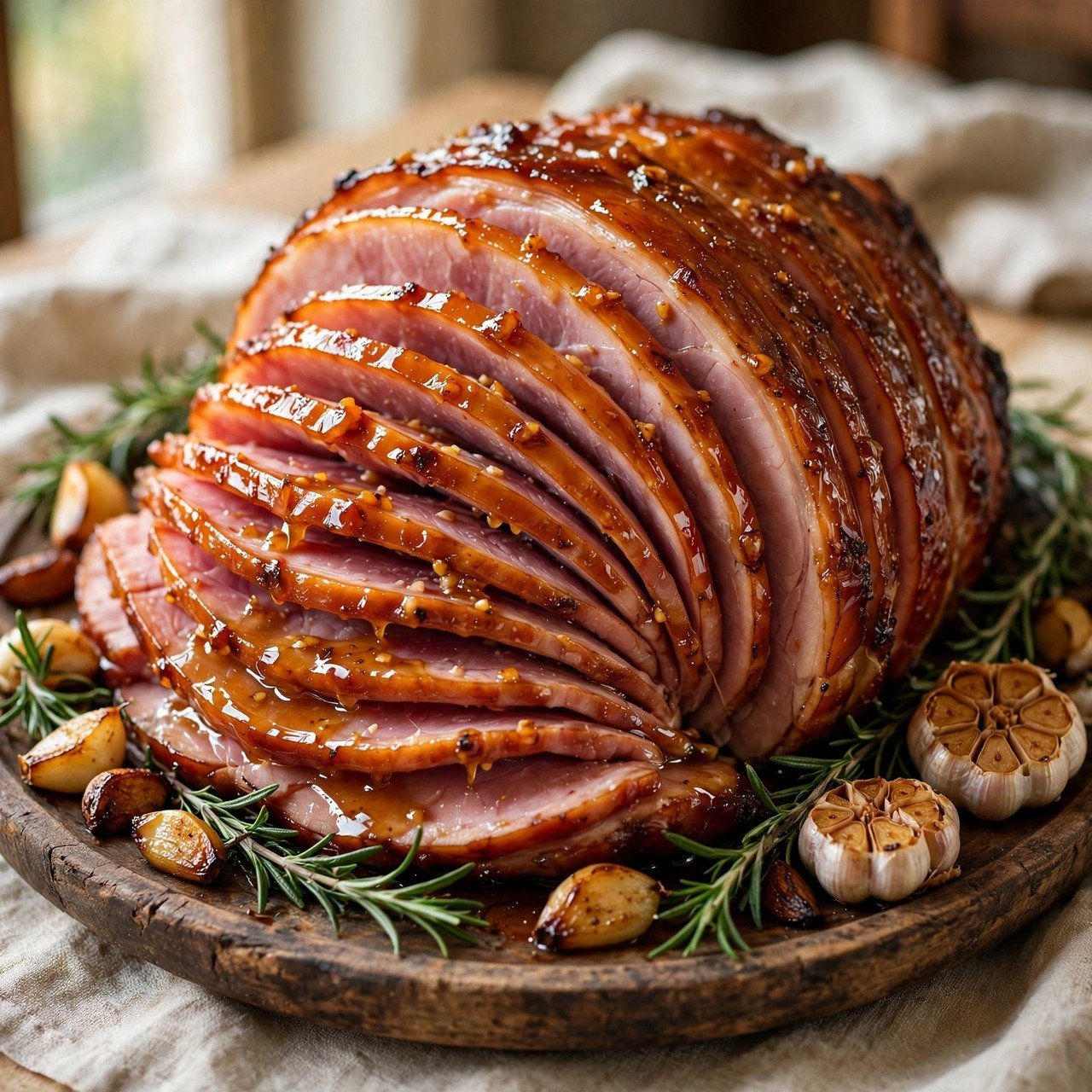
A spiral-sliced ham brushed with honey and garlic has become the Thanksgiving centerpiece that steals attention from the turkey, and this year it is everywhere. Gideon General’s honey-garlic ham went viral on TikTok this fall, and for good reason: a sticky, caramelized glaze, garlic that roasts into sweetness, and a ham that stays juicy instead of drying out. Below is one base method plus five variations, all built around a fully cooked, spiral-cut ham so the work is mostly in the glaze and the timing.
Why You’ll Love This Honey-Garlic Ham
Most holiday hams fail in one of two ways: they dry out in a long oven bake, or the glaze slides off and burns on the pan. This recipe fixes both. The ham is wrapped tightly in foil for the first hour, which traps steam and reheats the meat gently at 325°F without drying the edges. Then the foil comes off, the glaze goes on in three thin coats, and a short blast at 425°F caramelizes the surface into a lacquered, sticky crust.
The garlic matters more than people expect. Raw garlic in a glaze can taste sharp and bitter, but here the garlic is simmered in the honey mixture for five minutes first, which tames the bite and turns it mellow and sweet. The result is a glaze that tastes like roasted garlic and honey had a baby: savory, sweet, and complex enough that guests will ask what is in it.
Ingredients You’ll Need
This list makes one 8 to 10 pound fully cooked, bone-in, spiral-sliced ham, serving 12 to 14 people.
- 1 fully cooked bone-in spiral-sliced ham, 8 to 10 pounds
- 1 cup honey
- 6 cloves garlic, minced
- 1/2 cup packed light brown sugar
- 1/4 cup apple cider vinegar
- 2 tablespoons Dijon mustard
- 1 tablespoon soy sauce
- 1 teaspoon ground cinnamon
- 1/2 teaspoon ground cloves
- 1/2 teaspoon black pepper
- 1 cup water or low-sodium chicken broth, for the pan
- Fresh rosemary sprigs and orange slices, for serving
How to Make Honey-Garlic Ham
Step 1: Bring the ham to room temperature. Set the ham on the counter for 45 minutes before baking. A cold ham straight from the fridge reheats unevenly, with a hot outside and a lukewarm center. While it rests, heat the oven to 325°F and line a large roasting pan with foil.
Step 2: Make the glaze. Combine the honey, garlic, brown sugar, apple cider vinegar, Dijon, soy sauce, cinnamon, cloves, and black pepper in a small saucepan. Bring to a gentle simmer over medium heat, stirring until the sugar dissolves, about 3 minutes. Reduce the heat to low and simmer for 5 minutes more so the garlic softens and the glaze thickens slightly. It should coat the back of a spoon. Set aside.
Step 3: Wrap and bake. Place the ham cut-side down in the roasting pan and pour the water or broth into the bottom of the pan. This liquid steams the ham as it bakes and keeps the drippings from burning. Cover the pan tightly with foil, crimping the edges, and bake for 12 minutes per pound, about 1 hour 45 minutes for a 9-pound ham, until the center reads 130°F on an instant-read thermometer.
Step 4: Glaze in three coats. Remove the foil and brush the ham generously with one-third of the glaze, working it between the slices with a pastry brush. Return the ham to the oven, uncovered, for 15 minutes. Repeat the brushing and baking twice more, for a total of 45 minutes of glazing time. The glaze should look glossy and slightly tacky, not runny.
Step 5: Caramelize and rest. Raise the oven to 425°F and bake for 8 to 10 minutes more, watching closely, until the glaze bubbles and darkens at the edges. Transfer the ham to a platter, tent loosely with foil, and rest for 15 minutes before slicing. Resting lets the juices redistribute so the slices stay moist. Garnish with rosemary and orange slices and serve with the pan drippings spooned over the top.
Tips for the Best Honey-Garlic Ham Every Time
Score the glaze timing, not the clock. Ovens vary, and the only number that matters is the internal temperature: pull the ham at 140°F after glazing, since carryover heat will carry it to a safe 145°F while it rests. A ham that goes to 160°F in the oven will be dry no matter how good the glaze is.
Buy a spiral-sliced ham if you can. The slices let the glaze seep between the layers, so every piece is coated, and carving takes about thirty seconds. If you only have an unsliced ham, score the surface in a diamond pattern about 1/4 inch deep before glazing so the flavor has somewhere to go.
Do not skip the pan liquid. That cup of water or broth is doing two jobs: it steams the ham from below and it catches the glaze drips before they scorch. If the pan looks dry halfway through, add another 1/2 cup of hot water.
Easy Variations
Classic Honey-Garlic: The base recipe as written. Pure honey, garlic, and brown sugar with a Dijon backbone.
Brown Sugar and Dijon: Double the brown sugar to 1 cup and the Dijon to 1/4 cup, and leave out the soy sauce. The glaze turns thicker and more mustard-forward, almost like a ham steak sauce, and it is excellent on leftover ham sandwiches.
Spicy Chili-Honey: Add 2 tablespoons of chili crisp or 1 teaspoon of red pepper flakes to the glaze. The heat blooms in the honey and gives the ham a slow, warm finish without overwhelming the garlic. This is the version for the table that likes a little kick.
Pineapple and Clove: Replace the water in the pan with 1 cup of pineapple juice and stud the ham with whole cloves before the first glaze coat. The pineapple adds a bright, tropical acidity that cuts the richness, and it is the closest thing to the classic holiday ham most people grew up with.
Garlic Herb Butter: Stir 4 tablespoons of melted butter and 2 tablespoons of chopped fresh thyme into the glaze at the end. The butter makes the glaze richer and helps it cling, and the thyme adds a savory, woodsy note that pairs beautifully with roasted vegetables.
Storage and Reheating
Let the ham cool completely, then slice what remains and store it in an airtight container with a spoonful of pan drippings poured over the top. It keeps in the fridge for 4 to 5 days and in the freezer, wrapped tightly in foil and a freezer bag, for up to 2 months. To reheat, place slices in a baking dish with 2 tablespoons of water or broth, cover with foil, and warm at 300°F for 15 to 20 minutes until the center reaches 140°F. Microwaving works in a pinch, but cover the plate and heat in 30-second bursts so the edges do not turn rubbery.
Frequently Asked Questions
Can I use a boneless ham? Yes. A boneless ham reheats faster, so reduce the covered baking time to 10 minutes per pound and check the temperature early. The glaze steps stay the same.
Why did my glaze burn? Honey burns fast above 400°F, and a glaze applied too early spends too long in the heat. Keep the ham covered until the last 45 minutes, and do not raise the oven to 425°F until the final caramelization step. If the glaze darkens too fast, tent the ham loosely with foil.
Can I make this in a slow cooker? Yes, and it is a great way to free up oven space. Cook the ham on low for 4 to 5 hours with 1/2 cup of broth in the bottom, then brush with glaze and finish under the broiler for 3 to 5 minutes to caramelize. Watch it constantly under the broiler.
How much ham do I need per person? Plan on 3/4 pound per person for a bone-in ham, since the bone accounts for part of the weight. For a boneless ham, 1/2 pound per person is plenty. When in doubt, buy a little extra: leftover ham is the most useful holiday leftover there is.
Nutrition Estimate
One serving, about 4 ounces of ham with glaze, contains roughly 290 calories, 22 grams of protein, 18 grams of carbohydrates, 14 grams of fat, and 980 milligrams of sodium. This is an estimate only, and actual values vary with the size of the ham and how much glaze ends up on each slice.
The Bottom Line
Honey-garlic ham earns its viral moment the honest way: it is easier than turkey, more forgiving than a roast, and the glaze does the heavy lifting. Wrap it, bake it, glaze it three times, and give it a short hot finish. The result is a sticky, garlicky, caramelized centerpiece that looks like you worked all day and tastes like you knew exactly what you were doing.