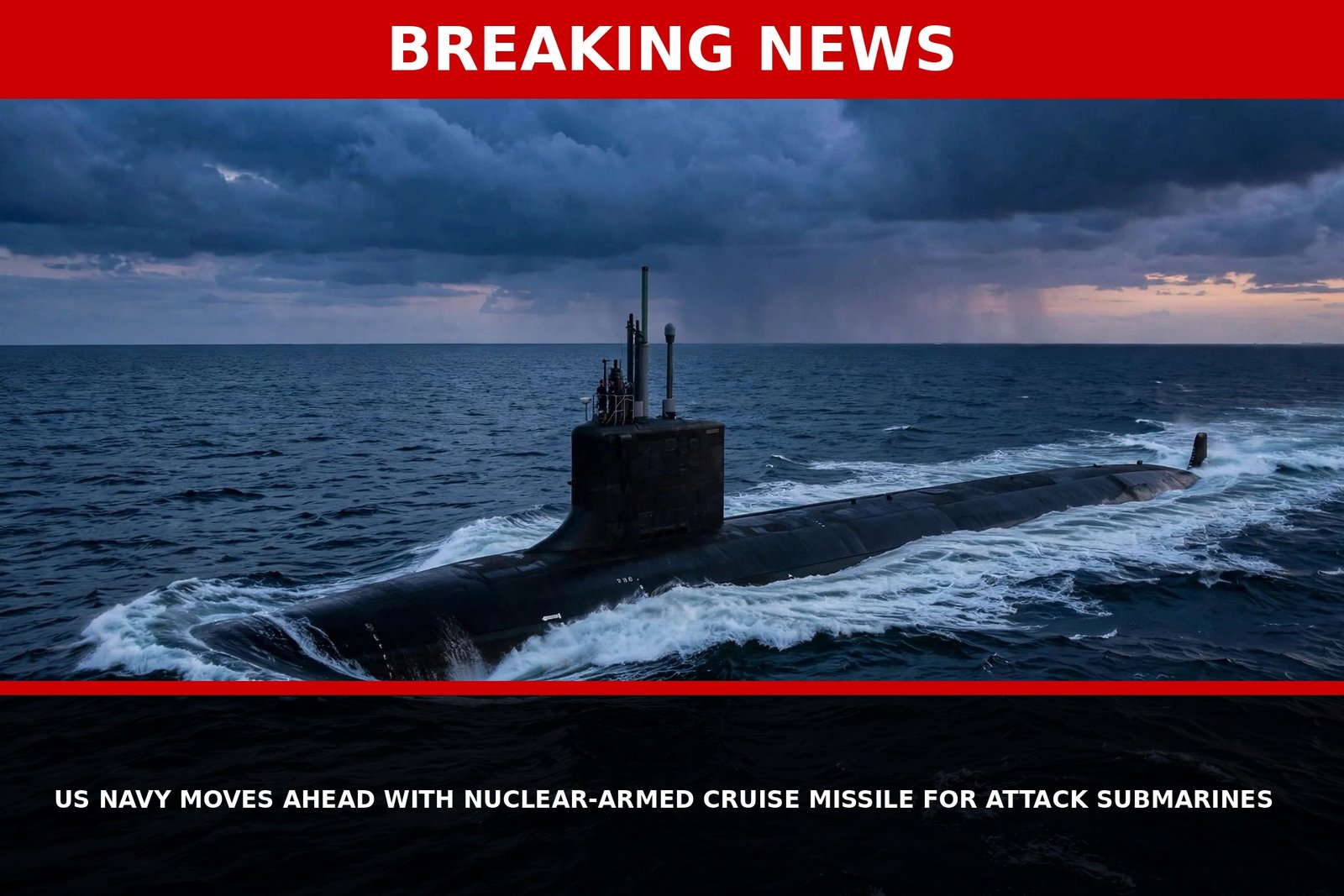
The U.S. Navy has taken a major step toward putting nuclear weapons back on its attack submarines, awarding Raytheon an agreement to move its nuclear-armed sea-launched cruise missile out of early concept work and into focused development.
RTX, Raytheon’s parent company, announced on November 24 that the Navy had awarded the agreement under its Other Transaction Authority, a contracting route the Pentagon uses for prototype work. Raytheon’s Advanced Technology team will now “mature the system’s design, integrate key subsystems and prepare for future prototype demonstrations,” according to the company.
The weapon, known as the SLCM-N — the Nuclear-Armed Sea-Launched Cruise Missile — is planned to arm some of the Navy’s Virginia-class nuclear-powered attack submarines. It would restore a capability the United States gave up more than a decade ago, when the nuclear-armed Tomahawk cruise missile was retired in 2013.
What the SLCM-N is
The SLCM-N is a low-yield, sea-launched nuclear cruise missile designed to give commanders a more flexible nuclear option in a regional conflict. According to U.S. Strategic Command, the missile would offer additional range, flexibility and survivability compared with other theater nuclear weapons.
The weapon is being developed for launch from a submerged large-diameter payload tube, such as the Virginia Payload Tubes or the Virginia Payload Module fitted to newer Virginia-class boats. The Navy has also said the missile is expected to arm the planned Trump-class battleship.
The warhead is a separate effort run by the Energy Department rather than the Navy. Sandia National Laboratories said in January 2026 that the missile would carry a new W80-5 warhead variant.
The program was first proposed in the 2018 Nuclear Posture Review, launched formally in December 2025, and has been kept alive by both Democratic and Republican lawmakers, who wrote a September 2034 deadline for initial operational capability into law.
The money and the timeline
The program is expensive, and its schedule is tight. A Government Accountability Office report released in July put the total acquisition cost of the SLCM-N at between $15 billion and $20 billion, and noted that the Navy’s 2034 target for initial operational capability is “aggressive.” The Congressional Budget Office has estimated development alone at about $10 billion through 2031, before production and integration.
The Navy has already spread the work across several contractors. In October, it said it had signed five SLCM-N prototype agreements worth $743.6 million on September 23, with work running through December 31, 2027. General Dynamics Mission Systems announced on October 19 a $194 million contract for engineering and technical work on the SLCM-N’s fire control subsystem, running through September 2028.
Raytheon’s team reaches beyond the established nuclear primes: it will draw on Anduril Rocket Motor Systems for propulsion, additive-manufacturing firm Divergent, and small turbine-engine maker Williams International. Raytheon did not disclose the value or duration of its new agreement, or when prototype demonstrations will begin.
Why it matters
The push to restore nuclear weapons to attack submarines is aimed squarely at deterrence in the western Pacific. “We are moving forward with [the] SLCM missile,” Vice-Admiral Richard Seif, commander of U.S. Submarine Forces, said this month. At a congressional hearing in March last year, Republican Senator Jim Banks was more explicit: “SLCM-N is meant to deter China.”
Supporters argue the weapon gives Washington more options in a Taiwan conflict: a missile that can be deployed covertly, reach targets faster than air-delivered nuclear gravity bombs, and better penetrate enemy defenses, while reassuring allies that the United States will protect them from nuclear coercion. Former Pacific Fleet intelligence director Jim Fanell made that case in recent reporting on the program.
The move is also rippling through allied capitals. Japan, home to the U.S. Seventh Fleet, is weighing an emergency exception to its long-standing ban on nuclear-armed American warships entering its ports — a debate one nuclear policy analyst said is likely being driven in part by the planned SLCM-N deployment. China’s defense ministry has accused “Japanese right-wing forces” of seeking to ease nuclear restrictions, saying it challenges the post-war international order.
What happens next
Watch for the first prototype demonstrations, which Raytheon has not yet dated, and for the Navy’s progress toward the 2034 operational deadline — a date its own program officials have called very aggressive. Fiscal 2026 legislation goes further, requiring a limited number of weapons to be ready for a limited operational deployment by September 2032.
The Navy has also appointed Rear Admiral Patrick Finney to advance the integration of the SLCM-N and the Conventional Prompt Strike hypersonic missile onto submarines and surface combatants, signaling that the sea-based nuclear and conventional strike programs are now moving together.
Featured image: AI-generated news illustration for Apkwonders News. Sources: reporting verified November 29, 2026, including The Aviationist, Defence Blog and South China Morning Post.