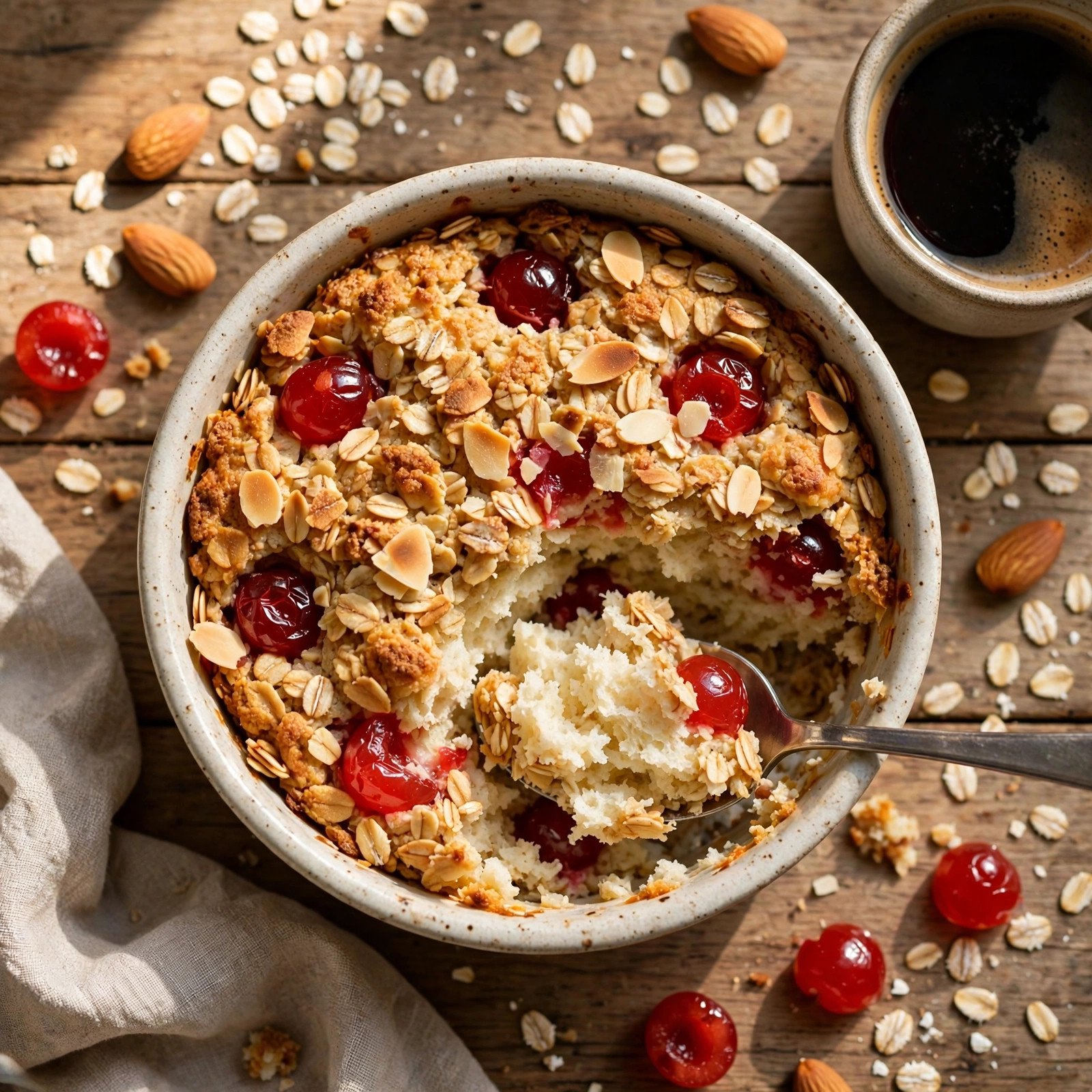
Why You’ll Love These Baked Oats
Baked oats are TikTok’s best breakfast idea in years: rolled oats blitzed into flour, whisked with egg, mashed banana, and milk, then baked in a ramekin until the batter rises like a little cake. Warm, puffed, tender — closer to a coffee-shop muffin top than to porridge.
The real appeal is the method. Learn why the oats must be blended, why the egg matters, and how the ramekin changes the bake, and you can riff into Cherry Bakewell, chocolate peanut butter, blueberry lemon, apple cinnamon, or carrot cake.
Ingredients You’ll Need
The master base every variation builds on — each ramekin serves 1 generously (or 2 as a lighter snack). Version-specific add-ins are under Easy Variations:
- 1/2 cup (45g) old-fashioned rolled oats — not steel-cut, not instant
- 1 large egg, at room temperature
- 1/2 ripe banana, mashed (about 1/4 cup)
- 1/4 cup milk (dairy, oat, almond, or soy)
- 1 tablespoon maple syrup or honey
- 1/2 teaspoon baking powder
- 1/4 teaspoon vanilla extract
- Pinch of fine salt
- Butter or nonstick spray for greasing
You need a blender or small food processor, plus an 8-ounce (1-cup) ramekin or oven-safe mug — a too-large vessel overbakes the edges before the center sets.
How to Make Baked Oats (The Master Method)
- Heat the oven to 350°F, rack in the center. The leavening and egg start setting structure the moment heat hits; a cold oven means an uneven bake with a dense bottom.
- Blend the oats into flour. Blitz 20–30 seconds until fine and powdery. Whole oats absorb liquid slowly, giving chewy porridge texture; ground to flour, they hydrate evenly, trap steam, and set into a tender, cake-like crumb.
- Whisk the wet base. Whisk the egg until frothy (about 20 seconds), then whisk in the banana, milk, maple syrup, and vanilla until smooth. The egg is structural: its proteins coagulate as they heat, forming the network that holds the risen batter together — which is how this works with zero wheat flour. The banana adds moisture, sweetness, and pectin for a tender crumb.
- Combine and rest 5 minutes — our non-negotiable rule. Stir the oat flour, baking powder, and salt into the wet mixture until just combined (small lumps are fine), fold in your version’s add-ins, and walk away for 5 minutes. Oat flour hydrates slower than wheat flour; baking immediately means the batter is still absorbing liquid in the oven — soggy bottom, gummy center.
- Fill the ramekin 3/4 full. Grease an 8-ounce ramekin well. Batter expands 25–30% as leavening activates and steam forms; overfilling is the number-one cause of overflow. For a family batch, multiply by 4 and bake in a greased 8×8-inch dish, 25–30 minutes.
- Bake 20–25 minutes at 350°F. Check at 18 minutes. Done means: top puffed and golden, edges pulling slightly from the ramekin, and the center passes the jiggle test — a gentle shake shows only the faintest wobble, and a toothpick comes out with moist crumbs, not wet batter. Carryover heat finishes the center, so pull at “almost,” not “completely.”
- Cool 5 minutes. The starches keep setting as it cools; cutting in early collapses the crumb.
Tips for the Best Baked Oats Every Time
Ramekin size changes the bake. A wider, shallower dish finishes in 15–18 minutes; a deep mug can need the full 25. Trust the jiggle test over the clock whenever you switch vessels. Use a room-temperature egg — a cold one adds minutes and unevenness; warm it in water for 5 minutes if you forgot.
Banana ripeness is a sweetness dial. Spotted and very ripe means maximum sweetness and tender crumb. Just-yellow tastes less sweet — bump maple syrup to 1 1/2 tablespoons. Do not overmix after the rest — fold gently, pour, bake.
The big three failures, fixed. Rubbery center = overbaked; use the jiggle test and pull early. Overflow = filled past 3/4 or old baking powder. Soggy bottom = skipped rest or a cool oven — most home ovens run 15–25°F off, so a cheap oven thermometer pays for itself.
Easy Variations
Make the master base through step 4 (including the rest), fold in the version’s ingredients, and bake — each serves 1–2 in an 8-ounce ramekin.
1. Cherry Bakewell Baked Oats
Add 1/4 teaspoon almond extract to the wet base with the vanilla (it turns soapy past that amount). Fold 3 tablespoons chopped glace or drained jarred dark cherries into the rested batter. Top with 1 tablespoon flaked almonds and 1 teaspoon coarse sugar — the almonds toast to deep gold and the sugar forms a crackly lid. Bake the full 20–25 minutes; serve with cherry jam warmed 15 seconds in the microwave, drizzled over like a tart glaze.
2. Chocolate Peanut Butter Baked Oats
Whisk 1 tablespoon unsweetened cocoa powder in with the dry oat flour (sift to prevent lumps). Fold 1 tablespoon chocolate chips into the rested batter, then dollop 1 tablespoon peanut butter on top and swirl once with a knife — swirled, not stirred, for molten ribbons. Reduce maple syrup to 2 teaspoons and bake 20–23 minutes; chocolate hides doneness, so trust the jiggle test over color. Natural-style peanut butter melts into glossy pockets; the emulsified kind stays stiff.
3. Blueberry Lemon Baked Oats
Add 1 teaspoon grated lemon zest and 1 teaspoon lemon juice to the wet base — the acid boosts lift and sharpens blueberry flavor the way salt sharpens chocolate. Fold in 1/3 cup fresh or frozen blueberries; frozen go in straight from the freezer, since thawing bleeds juice and grays the batter (add 2 minutes to the bake). Finish with a pinch of coarse sugar for a crackled crust.
4. Apple Cinnamon Baked Oats
Add 3/4 teaspoon cinnamon and 1/8 teaspoon nutmeg to the dry flour; reduce vanilla to 1/4 teaspoon so the spices lead. The technique twist: sauté 1/3 cup finely diced apple (Honeycrisp or Fuji, 1/4-inch dice) in 1 teaspoon butter with a pinch of cinnamon for 3 minutes before folding it in. Raw apple releases water as it bakes and leaves damp pockets; the quick sauté drives off moisture and caramelizes the sugars, so every bite tastes like apple pie filling. Top with 1 tablespoon chopped toasted pecans; bake 22–25 minutes.
5. Carrot Cake Baked Oats
Fold in 1/3 cup finely shredded carrot (small holes of a box grater — coarse shreds stay fibrous), 2 tablespoons raisins, 3/4 teaspoon cinnamon, 1/8 teaspoon nutmeg, and a pinch of ground ginger. The carrot nearly disappears, melting into sweetness and moisture like real carrot cake, while the raisins plump in the steam. Bake 22–25 minutes, then drizzle with a glaze of 2 tablespoons softened cream cheese whisked with 1 tablespoon powdered sugar and 1 teaspoon milk — apply to warm (not hot) oats, so it sits in ribbons instead of melting away.
Storage and Reheating
Cool completely, cover tightly, and refrigerate up to 4 days. Reheat a ramekin in the microwave 45–60 seconds — overheating turns it rubbery, so use short bursts. For the best texture, reheat in a 325°F oven for 8–10 minutes. To freeze: wrap tightly in plastic wrap then foil and freeze up to 2 months; thaw overnight in the fridge.
Frequently Asked Questions
Can I make baked oats without banana? Yes — swap in 1/4 cup unsweetened applesauce plus 1 extra teaspoon maple syrup, or 1/4 cup pumpkin purée with a pinch of cinnamon. Do not just omit it; you need that moisture and binding.
Can I prep it the night before? Assemble the batter, cover, and refrigerate overnight; in the morning stir gently and bake, adding 3–5 minutes. Or bake fully and reheat — the texture reheats beautifully. Never leave raw egg batter at room temperature overnight.
Is it gluten-free? It can be — but use oats labeled “certified gluten-free,” since conventional oats are usually cross-contaminated with wheat.
Why did mine come out dense and gummy? Three suspects: oats not blended fine enough (you need flour, not crumbs), the 5-minute rest skipped, or the bake ran long.
Can I make it without a blender? Buy oat flour and use 1/2 cup plus 1 tablespoon (it packs differently than home-blended). A food processor needs a full 60–90 seconds.
How do I scale for a family? Multiply by 4 and bake in a greased 8×8-inch dish at 350°F for 25–30 minutes, using the jiggle test in the center. Cut into 4–6 squares.
Nutrition Estimate
Per serving (1 ramekin, master base, 2% milk): approximately 340 calories, 11g protein, 52g carbohydrates, 6g fiber, 18g sugars, 10g fat, 2.5g saturated fat, 190mg sodium. Variations add roughly: Cherry Bakewell +90; Chocolate Peanut Butter +160; Blueberry Lemon +40; Apple Cinnamon +70; Carrot Cake +110 (including glaze). These are estimates only — actual values vary with ingredients, brands, and add-ins.
The Bottom Line
Baked oats earned their viral moment because the technique is genuinely sound, not just photogenic. Blend the oats fine, rest the batter five minutes, fill the ramekin three-quarters full, bake at 350°F until the center just barely jiggles, rest five more minutes. That is the entire method — a warm, cake-like breakfast from pantry staples in about 35 minutes.