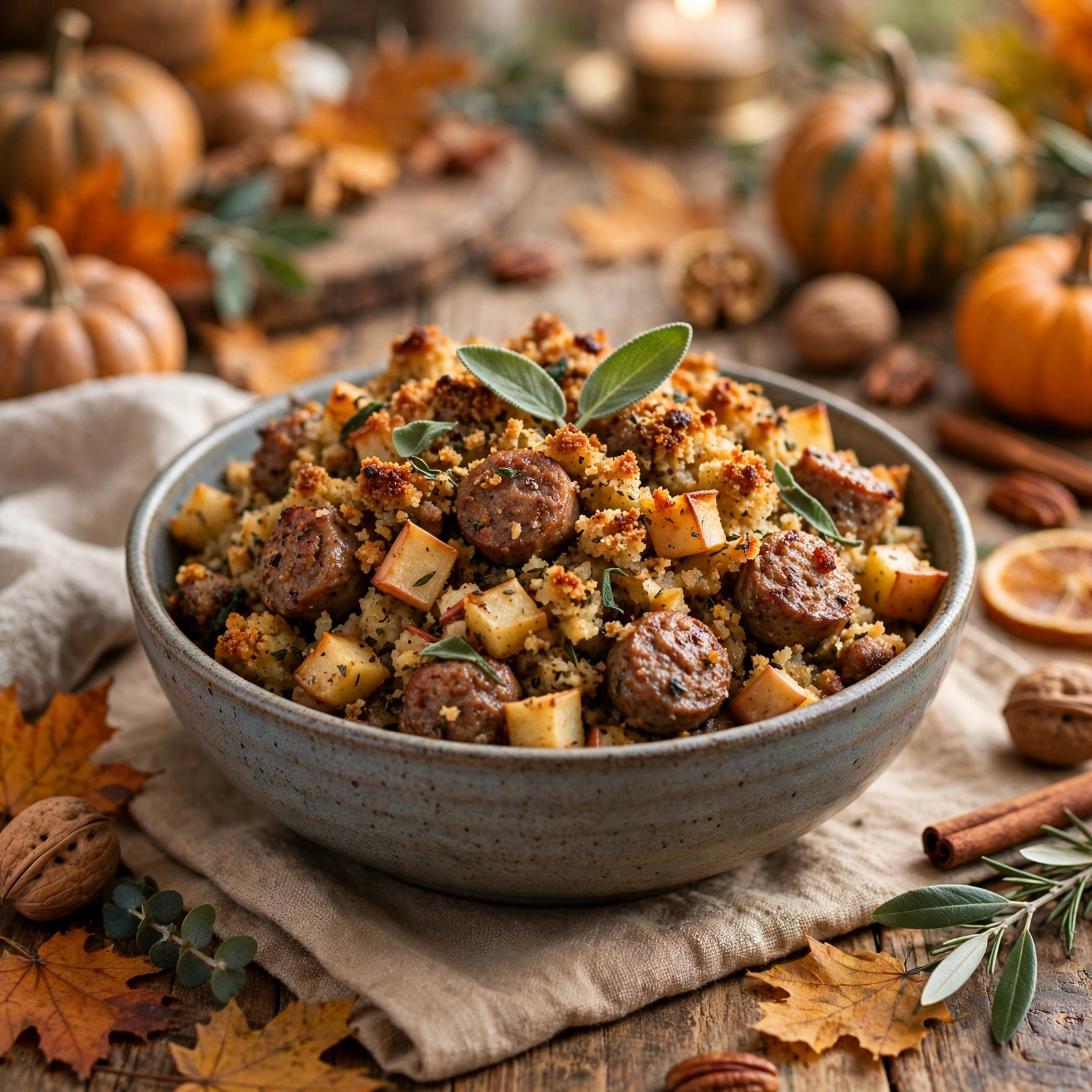
Why You’ll Love This Sausage and Apple Stuffing
Sausage and apple stuffing earns its place on the Thanksgiving table because it hits every note at once: savory and sweet, soft inside, crisp on top, and rich without feeling heavy. Sausage brings peppery depth and satisfying texture. Apples soften into tender, caramelized pockets that cut through the richness. Sage, thyme, and buttery bread tie it together into something that tastes like the holiday itself.
What sets this version apart is balance. Many stuffings lean too far one way: all sausage and no brightness, or so much fruit that the dish turns sweet and soggy. Here the apples are diced small and cooked just until tender, so they hold their shape and add sweetness without watering the bread down. The bread cubes are dried properly first, which is the real secret to stuffing that stays fluffy inside and crackles on top. It also assembles a day ahead, bakes while the turkey rests, and reheats beautifully.
Ingredients You’ll Need
- 1 pound pork sausage, bulk or removed from casings
- 2 tablespoons unsalted butter, plus more for the dish
- 1 large yellow onion, finely diced
- 3 celery stalks, finely diced
- 2 medium Honeycrisp or Granny Smith apples, peeled and diced
- 2 cloves garlic, minced
- 2 teaspoons chopped fresh sage
- 1 tablespoon chopped fresh thyme
- 10 cups day-old white bread cubes (about 1 1/2 pounds)
- 2 1/2 cups low-sodium chicken broth, divided
- 2 large eggs, lightly beaten
- 1/2 teaspoon kosher salt
- 1/2 teaspoon black pepper
- 1/4 teaspoon ground nutmeg (optional)
Choose a flavorful sausage: classic breakfast sausage or sweet Italian sausage both work, and hot Italian sausage is good if you like heat. Use a firm apple. Honeycrisp stays sweet and holds its shape, while Granny Smith adds tartness that balances rich sausage. Avoid soft apples such as Red Delicious, which collapse during baking.
How to Make Sausage and Apple Stuffing
- Dry the bread. If the bread is not already stale, spread the cubes on baking sheets and bake at 300 degrees Fahrenheit for 25 to 30 minutes, stirring once, until dry and lightly toasted but not browned. Cool completely. Drying matters because dry bread absorbs broth evenly instead of turning to paste, giving a fluffy interior rather than a dense, soggy one.
- Brown the sausage. Heat a large skillet over medium-high heat. Cook the sausage for 8 to 10 minutes, breaking it into small crumbles, until well browned with crispy edges. Browning builds flavor through caramelization and renders excess fat, so the stuffing tastes savory, not greasy. Transfer to a plate with a slotted spoon, leaving about 1 tablespoon of fat in the pan.
- Cook the vegetables and apples. Reduce heat to medium. Melt the butter, add onion and celery with a pinch of salt, and cook 8 to 10 minutes until softened. Add apples, garlic, sage, and thyme, and cook 4 to 5 minutes more, until the apples are just tender at the edges but still hold their shape. They will finish softening in the oven.
- Combine and add liquid. Preheat the oven to 375 degrees Fahrenheit and butter a 9 by 13-inch baking dish. In a large bowl, combine bread, sausage, and the vegetable-apple mixture with salt, pepper, and nutmeg, tossing gently. Whisk eggs into 2 cups of broth and pour over the bread in two additions, folding gently. The bread should look evenly moistened, not swimming. Add the remaining broth only a few tablespoons at a time if it still looks dry.
- Bake. Transfer to the dish, press down lightly just to even the surface, cover tightly with buttered foil, and bake 30 minutes. Remove foil and bake 20 to 25 minutes more, until the top is deeply golden and crisp, the edges bubble, and a thermometer in the center reads 165 degrees Fahrenheit. The top should crackle when pressed, while the center stays moist and steamy.
- Rest before serving. Rest 10 minutes before scooping. Resting lets the bread set and flavors settle, so servings hold together instead of falling apart. Garnish with sage leaves and serve warm.
Tips for the Best Stuffing Every Time
Start with truly dry bread. Even day-old bread can hold hidden moisture, so toasting it is worth the extra half hour. Dry bread drinks up broth gradually and keeps its structure, which is the difference between fluffy stuffing and wet bread pudding.
Season in layers. Salt the vegetables as they cook, season the bread before adding liquid, and taste before baking: microwave a small spoonful for 20 seconds and adjust salt or sage. Bland stuffing almost always comes from under-seasoning the bread, not a missing ingredient.
Watch the liquid. Different breads absorb differently, so add broth gradually and trust your eyes over the exact measurement. Too much liquid is the most common cause of soggy stuffing, so stop as soon as the cubes are damp throughout.
Easy Variations
1. Classic Sausage and Apple. Follow the base recipe with sweet Italian sausage, Honeycrisp apples, and sage. This is the balanced crowd-pleaser.
2. Cranberry and Walnut. Add 1 cup dried cranberries and 1 cup toasted chopped walnuts with the bread. Cranberries add tart sparkle, walnuts add crunch, and the combination looks beautiful on the table.
3. Cornbread and Apple. Replace half the white bread with crumbled day-old cornbread for a sweet, crumbly, Southern character. Cornbread absorbs more liquid, so add an extra 1/4 to 1/2 cup of broth and check texture before baking.
4. Mushroom and Herb. Add 8 ounces sliced cremini mushrooms, browned with the onions, plus extra sage, thyme, and 2 tablespoons chopped parsley. The mushrooms add earthy depth that pairs beautifully with turkey and gravy.
5. Spicy Chorizo and Apple. Swap in fresh Mexican chorizo, use Granny Smith apples, and add 1/2 teaspoon smoked paprika and a pinch of cayenne. The heat and smokiness play against sweet-tart apple and wake up the whole plate.
Storage and Reheating
Assemble up to one day ahead, cover tightly, and refrigerate; add 10 to 15 minutes to the covered baking time since it goes in cold. Or bake fully a day ahead, cool, cover, and refrigerate, then reheat covered at 350 degrees Fahrenheit for 25 to 30 minutes, uncovering for the last 10 minutes to re-crisp the top. Sprinkle a few tablespoons of broth over the surface first if it looks dry.
Leftovers keep in an airtight container in the refrigerator for up to 4 days. Reheat servings in the microwave for 1 to 2 minutes, or in a buttered skillet over medium heat for a crisped texture many people love even more than the first serving. Freeze baked stuffing in portions for up to 3 months; thaw overnight in the refrigerator. Always reheat to 165 degrees Fahrenheit, and never leave stuffing at room temperature for more than 2 hours.
Frequently Asked Questions
Can I stuff this into the turkey? Yes, but only loosely and only just before roasting, so heat circulates. Both turkey and stuffing must reach 165 degrees Fahrenheit. Most cooks get a better result baking stuffing separately, where the top can crisp properly.
Why is my stuffing soggy? Usually too much liquid, bread that was not dried enough, or both. Next time, dry the bread fully, add broth gradually, and bake uncovered at the end so steam escapes. If this batch is already soggy, spread it on a sheet pan and bake at 400 degrees Fahrenheit for 10 to 15 minutes.
Why is my stuffing dry? Dry stuffing usually means too little broth, over-toasted bread, or overbaking uncovered. Fix it by drizzling warm broth over the top and covering with foil for 10 minutes in a hot oven. Next time, pull it when the center is just steamy and the top is golden.
Can I make it vegetarian? Yes. Skip the sausage and use 12 ounces browned mushrooms plus 1 cup toasted pecans for savory depth, with vegetable broth. Add an extra tablespoon of butter and a little more sage to replace the sausage fat and seasoning.
What bread works best? Sturdy white sandwich bread, French bread, or challah all work, as long as cubes are dried. Very soft bread can work if toasted thoroughly, but avoid heavily seeded or strongly flavored breads that compete with sage and sausage.
Nutrition Estimate
Nutrition Estimate (per serving, based on 10 servings, approximate only): about 380 calories, 18 grams fat, 38 grams carbohydrates, 15 grams protein, 3 grams fiber, and 720 milligrams sodium. This is an estimate only. Actual values vary with the sausage, bread, and broth used, and this is not a substitute for professional dietary advice.
The Bottom Line
Dry the bread, brown the sausage, season in layers, and let it rest before serving, and you will get stuffing that is crisp on top, tender inside, and full of flavor in every spoonful. Pick one of the five variations, or make the classic and let the gravy do the rest. Either way, this is the side dish guests ask about.